







Amplitude-Complementary 2-Channel Filter Bank
A natural choice of analysis filters for our two-channel critically sampled filter bank is an amplitude-complementary lowpass/highpass pair, i.e.,
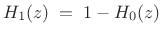 |
(12.24) |
where we impose the unity dc gain constraint
 . Note that
amplitude-complementary means constant overlap-add (COLA) on
the unit circle in the
. Note that
amplitude-complementary means constant overlap-add (COLA) on
the unit circle in the  plane.
Substituting the COLA constraint into the filtering and aliasing cancellation constraint (11.23) gives
![\begin{eqnarray*}
g\,z^{-d} &=& H_0(z)\left[1-H_0(-z)\right] - \left[1-H_0(z)\right]H_0(-z) \\ [5pt]
&=& H_0(z) - H_0(-z)\\ [5pt]
\;\longleftrightarrow\;\quad a(n) &=& h_0(n) - (-1)^n h_0(n) \\ [5pt]
&=& \left\{\begin{array}{ll}
0, & \hbox{$n$\ even} \\ [5pt]
2h_0(n), & \hbox{$n$\ odd} \\
\end{array} \right.
\end{eqnarray*}](http://www.dsprelated.com/josimages_new/sasp2/img2021.png)
Thus, we find that even-indexed terms of the impulse response are
unconstrained, since they subtract out in the constraint, while,
for perfect reconstruction, exactly one odd-indexed term
must be nonzero in the lowpass impulse response  . The
simplest choice is
. The
simplest choice is
 .
.
Thus, we have derived that the lowpass-filter impulse-response for channel 0 can be anything of the form
![$\displaystyle h_0 \eqsp [h_0(0), \bold{h_0(1)}, h_0(2), 0, h_0(4), 0, h_0(6), 0, \ldots] \protect$](http://www.dsprelated.com/josimages_new/sasp2/img2024.png)
or
![$\displaystyle h_0 \eqsp [h_0(0), 0, h_0(2), \bold{h_0(3)}, h_0(4), 0, h_0(6), 0, \ldots]$](http://www.dsprelated.com/josimages_new/sasp2/img2025.png) |
(12.26) |
etc. The corresponding highpass-filter impulse response is then
 |
(12.27) |
The first example (11.25) above goes with the highpass filter
![$\displaystyle h_1 \eqsp [1-h_0(0), -h_0(1), -h_0(2), 0, -h_0(4), 0, -h_0(6), 0, \ldots]$](http://www.dsprelated.com/josimages_new/sasp2/img2027.png) |
(12.28) |
and similarly for the other example.
The above class of amplitude-complementary filters can be characterized in general as follows:
![\begin{eqnarray*}
H_0(z) &=& E_0(z^2) + h_0(o) z^{-o}, \quad E_0(1)+h_0(o)\eqsp 1, \, \hbox{$o$\ odd}\\ [5pt]
H_1(z) &=& 1-H_0(z) \eqsp 1 - E_0(z^2) - h_0(o) z^{-o}
\end{eqnarray*}](http://www.dsprelated.com/josimages_new/sasp2/img2028.png)
In summary, we see that an amplitude-complementary
lowpass/highpass analysis filter pair yields perfect reconstruction
(aliasing and filtering cancellation) when there is exactly one
odd-indexed term in the impulse response of
.
Unfortunately, the channel filters are so constrained in form that it
is impossible to make a high quality lowpass/highpass pair. This
happens because  repeats twice around the unit circle. Since
we assume real coefficients, the frequency response,
repeats twice around the unit circle. Since
we assume real coefficients, the frequency response,
 is magnitude-symmetric about
 as
well as
as
well as  . This is not good since we only have one degree of
freedom,
. This is not good since we only have one degree of
freedom,
 , with which we can break the
  symmetry
to reduce the high-frequency gain and/or boost the low-frequency gain.
This class of filters cannot be expected to give high quality lowpass
or highpass behavior.
symmetry
to reduce the high-frequency gain and/or boost the low-frequency gain.
This class of filters cannot be expected to give high quality lowpass
or highpass behavior.
To achieve higher quality lowpass and highpass channel filters, we will need to relax the amplitude-complementary constraint (and/or filtering cancellation and/or aliasing cancellation) and find another approach.
Next Section:
Haar Example
Previous Section:
Two-Channel Critically Sampled Filter Banks












