Sign in

username:

password:


Not a member?

Search Online Books


Search tips

Free Online Books

Sponsor

Industry's highest performing at the lowest power DSPs now as low as $5.00*
Start development today!
*volume pricing for 10ku

Chapters

See Also

Embedded SystemsFPGAElectronics
Chapter Contents:

Search Spectral Audio Signal Processing


Book Index | Global Index


Would you like to be notified by email when Julius Orion Smith III publishes a new entry into his blog?


Choice of WOLA Window

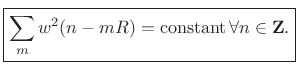
The synthesis (output) window in weighted overlap-add is typically chosen to be the same as the analysis (input) window, in which case the COLA constraint becomes
$\displaystyle \zbox {\sum_m w^2(n-mR) = \hbox{constant}\,\forall n\in{\bf Z}.}
$

We can say that $ R$-shifts of the window $ w$ in the time domain are power complementary, whereas for OLA they were amplitude complementary.

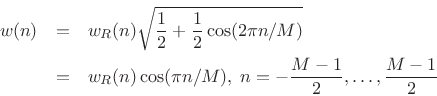
A trivial way to construct useful windows for WOLA is to take the square root of any good OLA window. This works for all non-negative OLA windows (which covers essentially all windows in Chapter 3 other than Portnoff windows). For example, the ``root-Hann window'' can be defined for odd $ M$ by

\begin{eqnarray*}
w(n) &=& w_R(n) \sqrt{\frac{1}{2} + \frac{1}{2} \cos( 2\pi n/M...
..._R(n) \cos(\pi n/M),
\; n= -\frac{M-1}{2},\ldots,\frac{M-1}{2}
\end{eqnarray*}

Notice that the root-Hann window is the same thing as the ``MLT Sine Window'' described in §3.2.6. We can similarly define the ``root-Hamming'', ``root-Blackman'', and so on, all of which give perfect reconstruction in the weighted overlap-add context.


Previous: WOLA Processing Steps
Next: Review of Zero Padding

Order a Hardcopy of Spectral Audio Signal Processing


About the Author: Julius Orion Smith III
Julius Smith's background is in electrical engineering (BS Rice 1975, PhD Stanford 1983). He is presently Professor of Music and Associate Professor (by courtesy) of Electrical Engineering at Stanford's Center for Computer Research in Music and Acoustics (CCRMA), teaching courses and pursuing research related to signal processing applied to music and audio systems. See http://ccrma.stanford.edu/~jos/ for details.


Comments


No comments yet for this page


Add a Comment
You need to login before you can post a comment (best way to prevent spam). ( Not a member? )