Computing Vocoder Parameters
To compute the amplitude  at the output of the
  th subband,
we can apply an envelope follower. Classically, such as in the
original vocoder, this can be done by full-wave rectification and
subsequent low pass filtering, as shown in Fig.G.10. This
produces an approximation of the average power in each subband.
th subband,
we can apply an envelope follower. Classically, such as in the
original vocoder, this can be done by full-wave rectification and
subsequent low pass filtering, as shown in Fig.G.10. This
produces an approximation of the average power in each subband.
![\begin{psfrags}
% latex2html id marker 42527\psfrag{x} []{ \LARGE$ x_k(t)$\ }\psfrag{xkt} []{ \LARGE$ \tilde{x}_k(t)$\ }\psfrag{xk} []{ \LARGE$ x_k(t)$\ }\psfrag{output} []{ \LARGE$ y_k=h*\tilde{x}_k $\ }\begin{figure}[htbp]
\includegraphics[width=\textwidth ]{eps/envelope}
\caption{Classic method for amplitude envelope
extraction in continuous-time analog circuits.}
\end{figure}
\end{psfrags}](http://www.dsprelated.com/josimages_new/sasp2/img3001.png)
In digital signal processing, we can do much better than the classical amplitude-envelope follower: We can measure instead the instantaneous amplitude of the (assumed quasi sinusoidal) signal in each filter band using so-called analytic signal processing (introduced in §4.6). For this, we generalize (G.3) to the real-part of the corresponding analytic signal:
![$\displaystyle x_k(t)\eqsp a_k(t)\cos[ \omega_kt + \phi_k(t) ] \eqsp$](http://www.dsprelated.com/josimages_new/sasp2/img3002.png)


In general, when both amplitude and phase are needed, we must compute two real signals for each vocoder channel:


 (instantaneous amplitude)
 (instantaneous phase)
![$\displaystyle \tan^{-1} \left[ \frac{\mbox{im\ensuremath{\left\{x_k^a(t)\right\}}}}
{\mbox{re\ensuremath{\left\{x_k^a(t)\right\}}}} \right] - \omega_kt
\protect$](http://www.dsprelated.com/josimages_new/sasp2/img3011.png)
We call
the instantaneous amplitude at time  for
both
for
both  and
and  . The function
 as a whole is
called the amplitude envelope of the
th channel output.
The instantaneous phase at time
is
as a whole is
called the amplitude envelope of the
th channel output.
The instantaneous phase at time
is  , and its
time-derivative is instantaneous frequency.
, and its
time-derivative is instantaneous frequency.
In order to determine these signals, we need to compute the analytic
signal
from its real part
. Ideally, the imaginary
part of the analytic signal is obtained from its real part using
the Hilbert transform (§4.6), as shown
in Fig.G.11.
![\begin{psfrags}
% latex2html id marker 42563\psfrag{x} []{ \LARGE$ x_k(t)$\ }\psfrag{Rex} []{ \LARGE$ \mbox{re\ensuremath{\left\{x_k^a(t)\right\}}}$\ }\psfrag{Imx} []{ \LARGE$ \mbox{im\ensuremath{\left\{x_k^a(t)\right\}}}$\ }\begin{figure}[htbp]
\includegraphics[width=0.8\twidth]{eps/hilbert}
\caption{Creating an analytic signal
from its real part using the Hilbert transform
(\textit{cf.}{} \sref {hilbert}).}
\end{figure}
\end{psfrags}](http://www.dsprelated.com/josimages_new/sasp2/img3015.png)
Using the Hilbert-transform filter, we obtain the analytic signal in ``rectangular'' (Cartesian) form:
    |
(G.7) |
To obtain the instantaneous amplitude and phase, we simply convert each complex value of
to polar form
![$\displaystyle x_k^a(t) \eqsp a_k(t)\,e^{j[ \omega_kt +\phi_k(t)] }$](http://www.dsprelated.com/josimages_new/sasp2/img3020.png) |
(G.8) |
as given by (G.6).
Frequency Envelopes
It is convenient in practice to work with instantaneous frequency deviation instead of phase:
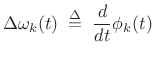 |
(G.9) |
Since the
th channel of an  -channel uniform filter-bank has
nominal bandwidth given by
-channel uniform filter-bank has
nominal bandwidth given by  , the frequency deviation usually
does not exceed
, the frequency deviation usually
does not exceed
 .
.
Note that
is a narrow-band signal centered about the channel
frequency  . As detailed in Chapter 9, it is typical
to heterodyne the channel signals to ``base band'' by shifting
the input spectrum by
. As detailed in Chapter 9, it is typical
to heterodyne the channel signals to ``base band'' by shifting
the input spectrum by  so that the channel bandwidth is
centered about frequency zero (dc). This may be expressed by
modulating the analytic signal by
so that the channel bandwidth is
centered about frequency zero (dc). This may be expressed by
modulating the analytic signal by
 to get
 |
(G.10) |
The `b' superscript here stands for ``baseband,'' i.e., the channel-filter frequency-response is centered about dc. Working at baseband, we may compute the frequency deviation as simply the time-derivative of the instantaneous phase of the analytic signal:
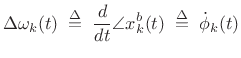 |
(G.11) |
where
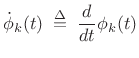 |
(G.12) |
denotes the time derivative of
. For notational
simplicity, let
 and
and
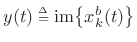 . Then we have
 |
(G.13) |
For discrete time, we replace
by  to obtain [186]

Initially, the sliding FFT was used (hop size
 in the
notation of Chapters 8 and 9). Larger hop sizes can result in phase
ambiguities, i.e., it can be ambiguous exactly how many cycles of a
quasi-sinusoidal component occurred during the hop within a given
channel, especially for high-frequency channels. In many
applications, this is not a serious problem, as it is only necessary
to recreate a psychoacoustically equivalent peak trajectory in the
short-time spectrum. For related discussion,
see [299].
in the
notation of Chapters 8 and 9). Larger hop sizes can result in phase
ambiguities, i.e., it can be ambiguous exactly how many cycles of a
quasi-sinusoidal component occurred during the hop within a given
channel, especially for high-frequency channels. In many
applications, this is not a serious problem, as it is only necessary
to recreate a psychoacoustically equivalent peak trajectory in the
short-time spectrum. For related discussion,
see [299].
Using (G.6) and (G.14) to compute the instantaneous amplitude and frequency for each subband, we obtain data such as shown qualitatively in Fig.G.12. A matlab algorithm for phase unwrapping is given in §F.4.1.
![\begin{psfrags}
% latex2html id marker 42622\psfrag{ak} []{ \LARGE$ a_k(t)$\ }\psfrag{wkt} []{ \LARGE$ \Delta\omega_k(t)=\dot{\phi_k}(t) $\ }\psfrag{wk} []{ \LARGE$ 0 $\ }\psfrag{t} []{ \LARGE$ t$\ }\begin{figure}[htbp]
\includegraphics[width=3.5in]{eps/traj}
\caption{Example amplitude envelope (top)
and frequency envelope (bottom).}
\end{figure}
\end{psfrags}](http://www.dsprelated.com/josimages_new/sasp2/img3033.png)
Envelope Compression
Once we have our data in the form of amplitude and frequency envelopes
for each filter-bank channel, we can compress them by a large factor.
If there are
channels, we nominally expect to be able to
downsample by a factor of
, as discussed initially in Chapter 9
and more extensively in Chapter 11.
In early computer music [97,186], amplitude and frequency envelopes were ``downsampled'' by means of piecewise linear approximation. That is, a set of breakpoints were defined in time between which linear segments were used. These breakpoints correspond to ``knot points'' in the context of polynomial spline interpolation [286]. Piecewise linear approximation yielded large compression ratios for relatively steady tonal signals.G.10For example, compression ratios of 100:1 were not uncommon for isolated ``toots'' on tonal orchestral instruments [97].
A more straightforward method is to simply downsample each envelope by
some factor. Since each subband is bandlimited to the channel
bandwidth, we expect a downsampling factor on the order of the number
of channels in the filter bank. Using a hop size  in the STFT
results in downsampling by the factor
in the STFT
results in downsampling by the factor  (as discussed
in §9.8). If
channels are downsampled by
, then the
total number of samples coming out of the filter bank equals the
number of samples going into the filter bank. This may be called
critical downsampling, which is invariably used in filter banks
for audio compression, as discussed further in Chapter 11. A benefit
of converting a signal to critically sampled filter-bank form is that
bits can be allocated based on the amount of energy in each subband
relative to the psychoacoustic masking threshold in that band.
Bit-allocation is typically different for tonal and noise signals in a
band [113,25,16].
(as discussed
in §9.8). If
channels are downsampled by
, then the
total number of samples coming out of the filter bank equals the
number of samples going into the filter bank. This may be called
critical downsampling, which is invariably used in filter banks
for audio compression, as discussed further in Chapter 11. A benefit
of converting a signal to critically sampled filter-bank form is that
bits can be allocated based on the amount of energy in each subband
relative to the psychoacoustic masking threshold in that band.
Bit-allocation is typically different for tonal and noise signals in a
band [113,25,16].
Vocoder-Based Additive-Synthesis Limitations
Using the phase-vocoder to compute amplitude and frequency envelopes for additive synthesis works best for quasi-periodic signals. For inharmonic signals, the vocoder analysis method can be unwieldy: The restriction of one sinusoid per subband leads to many ``empty'' bands (since radix-2 FFT filter banks are always uniformly spaced). As a result, we have to compute many more filter bands than are actually needed, and the empty bands need to be ``pruned'' in some way (e.g., based on an energy detector within each band). The unwieldiness of a uniform filter bank for tracking inharmonic partial overtones through time led to the development of sinusoidal modeling based on the STFT, as described in §G.11.2 below.
Another limitation of the phase-vocoder analysis was that it did not capture the attack transient very well in the amplitude and frequency envelopes computed. This is because an attack transient typically only partially filled an STFT analysis window. Moreover, filter-bank amplitude and frequency envelopes provide an inefficient model for signals that are noise-like, such as a flute with a breathy attack. These limitations are addressed by sinusoidal modeling, sines+noise modeling, and sines+noise+transients modeling, as discussed starting in §10.4 below (as well as in §10.4).
The phase vocoder was not typically implemented as an identity system due mainly to the large data reduction of the envelopes (piecewise linear approximation). However, it could be used as an identity system by keeping the envelopes at the full signal sampling rate and retaining the initial phase information for each channel. Instantaneous phase is then reconstructed as the initial phase plus the time-integral of the instantaneous frequency (given by the frequency envelope).
Next Section:
Further Reading on Vocoders
Previous Section:
FM Voice