DFT Filter Bank
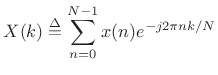
Recall that the Length  Discrete Fourier Transform (DFT) is
defined as
Discrete Fourier Transform (DFT) is
defined as
 |
(10.13) |
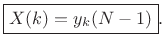
Comparing this to (9.12), we see that the filter-bank output
 ,
,
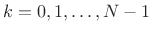 , is precisely the DFT of the input signal
when
, is precisely the DFT of the input signal
when  , i.e.,
 |
(10.14) |
In other words, the filter-bank output at time
(the set of
samples  for
for
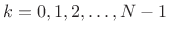 ), equals the DFT of the
first
samples of
), equals the DFT of the
first
samples of  (
( ,
,
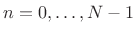 ). That is, taking
a snapshot of all filter-bank channels at time
). That is, taking
a snapshot of all filter-bank channels at time  yields the DFT of
the input data from time 0
through
.
yields the DFT of
the input data from time 0
through
.
More generally, for all  , we will call Fig.9.15 the DFT
filter bank. The DFT filter bank is the special case of the STFT for
which a rectangular window and hop size
, we will call Fig.9.15 the DFT
filter bank. The DFT filter bank is the special case of the STFT for
which a rectangular window and hop size  are used.
The sliding DFT is obtained by advancing successive DFTs by one sample:
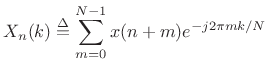 |
(10.15) |
When
 for any integer
  , the Sliding DFT coincides with the
DFT filter bank. At other times, they differ by a linear phase
term. (Exercise: find the linear phase term.)
The Sliding DFT redefines the time origin every sampling period
(each modulation term within the DFT starts at time 0 for each
transform), while the DFT Filter Bank does not redefine the time
origin (modulation terms are ``free running'' as they would be in an
analog filter bank). Since ``DFT time'' repeats every
samples,
the two treatments coincide every
samples (i.e.,
, the Sliding DFT coincides with the
DFT filter bank. At other times, they differ by a linear phase
term. (Exercise: find the linear phase term.)
The Sliding DFT redefines the time origin every sampling period
(each modulation term within the DFT starts at time 0 for each
transform), while the DFT Filter Bank does not redefine the time
origin (modulation terms are ``free running'' as they would be in an
analog filter bank). Since ``DFT time'' repeats every
samples,
the two treatments coincide every
samples (i.e.,
 for every integer
).
for every integer
).
When
is a power of 2, the DFT can be implemented using a Cooley-Tukey Fast
Fourier Transform (FFT) using only
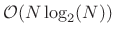 operations per
transform. By keeping track of the linear phase term (an
operations per
transform. By keeping track of the linear phase term (an
 modification), a DFT Filter Bank can be implemented efficiently using
an FFT. Uniform FIR filter banks are very often implemented in
practice using FFT software such as fftw.
modification), a DFT Filter Bank can be implemented efficiently using
an FFT. Uniform FIR filter banks are very often implemented in
practice using FFT software such as fftw.
Note that the channel bandwidths are narrow compared with half
the sampling rate (especially for large
), so that the filter bank
output signals
are oversampled, in general. We will
later look at downsampling the channel signals
to
obtain a ``hopping FFT'' filter bank. ``Sliding'' and ``hopping''
FFTs are special cases of the discrete-time Short Time Fourier
Transform (STFT). The STFT normally also uses a window
function other than the rectangular window used in this development
(the running-sum lowpass filter).
Next Section:
Inverse DFT and the DFT Filter Bank Sum
Previous Section:
System Diagram of the Running-Sum Filter Bank