Discrete Wavelet Filterbank
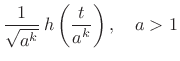
In a discrete wavelet filterbank, each basis signal is
interpreted as the impulse response of a bandpass filter in a
constant-Q filter bank:
 |
 |
 |
|
 |
|
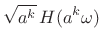 |
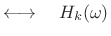
Thus, the
 th channel-filter
 is obtained by
frequency-scaling (and normalizing for unit energy) the zeroth
channel filter
is obtained by
frequency-scaling (and normalizing for unit energy) the zeroth
channel filter
 . The frequency scale-factor is of course
equal to the inverse of the time-scale factor.
. The frequency scale-factor is of course
equal to the inverse of the time-scale factor.
Recall that in the STFT, channel filter
is a shift of
the zeroth channel-filter
(which corresponds to ``cosine
modulation'' in the time domain).
As the channel-number
increases, the channel impulse response
 lengthens by the factor
  ., while the pass-band of its
frequency-response
., while the pass-band of its
frequency-response  narrows by the inverse factor
  .
.
Figure 11.32 shows a block diagram of the discrete wavelet
filter bank for  (the ``dyadic'' or ``octave filter-bank'' case),
and Fig.11.33 shows its time-frequency tiling as compared to
that of the STFT. The synthesis filters
(the ``dyadic'' or ``octave filter-bank'' case),
and Fig.11.33 shows its time-frequency tiling as compared to
that of the STFT. The synthesis filters  may be used to make
a biorthogonal filter bank. If the
are orthonormal, then
may be used to make
a biorthogonal filter bank. If the
are orthonormal, then
 .
.
![\includegraphics[width=\twidth]{eps/DyadicFilterbank}](http://www.dsprelated.com/josimages_new/sasp2/img2371.png)
![\includegraphics[width=0.8\twidth]{eps/DyadicTiling}](http://www.dsprelated.com/josimages_new/sasp2/img2372.png) |
Next Section:
Dyadic Filter Banks
Previous Section:
Discrete Wavelet Transform