Dolph-Chebyshev Window
The Dolph-Chebyshev Window (or Chebyshev window, or
Dolph window) minimizes the Chebyshev norm of the side
lobes for a given main-lobe width  [61,101],
[224, p. 94]:
[61,101],
[224, p. 94]:
 |
(4.43) |
The Chebyshev norm is also called the
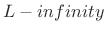 norm, uniform
norm, minimax norm, or simply the maximum absolute value.
norm, uniform
norm, minimax norm, or simply the maximum absolute value.
An equivalent formulation is to minimize main-lobe width subject to a side-lobe specification:
 |
(4.44) |
The optimal Dolph-Chebyshev window transform can be written in closed form [61,101,105,156]:
![\begin{eqnarray*}
W(\omega_k) &=& \frac{\cos\left\{M\cos^{-1}\left[\beta\cos\left(\frac{\pi k}{M}\right)
\right]\right\}}{\cosh\left[M\cosh^{-1} (\beta)\right]},
\qquad k=0,1,2,\ldots,M-1 \\
\beta &=& \cosh \left[\frac{1}{M}\cosh^{-1}(10^\alpha)\right], \qquad (\alpha\approx 2,3,4).
\end{eqnarray*}](http://www.dsprelated.com/josimages_new/sasp2/img520.png)
The zero-phase Dolph-Chebyshev window,  , is then computed as the
inverse DFT of
, is then computed as the
inverse DFT of
 .4.14 The
  parameter controls the side-lobe level via the formula [156]
Side-Lobe Level in dB |
(4.45) |
Thus,
 gives side-lobes which are
  dB below the
main-lobe peak. Since the side lobes of the Dolph-Chebyshev window
transform are equal height, they are often called ``ripple in the
stop-band'' (thinking now of the window transform as a lowpass filter
frequency response). The smaller the ripple specification, the larger
dB below the
main-lobe peak. Since the side lobes of the Dolph-Chebyshev window
transform are equal height, they are often called ``ripple in the
stop-band'' (thinking now of the window transform as a lowpass filter
frequency response). The smaller the ripple specification, the larger
 has to become to satisfy it, for a given window length
  .
.
The Chebyshev window can be regarded as the impulse response of an optimal Chebyshev lowpass filter having a zero-width pass-band (i.e., the main lobe consists of two ``transition bands''--see Chapter 4 regarding FIR filter design more generally).
Matlab for the Dolph-Chebyshev Window
In Matlab, the function chebwin(M,ripple) computes a length
Dolph-Chebyshev window having a side-lobe level ripple dB below
that of the main-lobe peak. For example,
w = chebwin(31,60);designs a length
 window with side lobes at
  dB (when the main-lobe
peak is normalized to 0 dB).
dB (when the main-lobe
peak is normalized to 0 dB).
Example Chebyshev Windows and Transforms
Figure 3.31 shows the Dolph-Chebyshev window and its transform as designed by chebwin(31,40) in Matlab, and Fig.3.32 shows the same thing for chebwin(31,200). As can be seen from these examples, higher side-lobe levels are associated with a narrower main lobe and more discontinuous endpoints.
 Dolph-Chebyshev window
with ripple (side-lobe level) specified to be
Dolph-Chebyshev window
with ripple (side-lobe level) specified to be 
![\includegraphics[width=\twidth]{eps/cheb31R40}](http://www.dsprelated.com/josimages_new/sasp2/img528.png)

![\includegraphics[width=\twidth]{eps/cheb31R200}](http://www.dsprelated.com/josimages_new/sasp2/img529.png)
 Dolph-Chebyshev window
with ripple (side-lobe level) specified to be
Dolph-Chebyshev window
with ripple (side-lobe level) specified to be ![\includegraphics[width=\twidth]{eps/cheb101R40}](http://www.dsprelated.com/josimages_new/sasp2/img530.png)
Figure 3.33 shows the Dolph-Chebyshev window and its transform as designed by chebwin(101,40) in Matlab. Note how the endpoints have actually become impulsive for the longer window length. The Hamming window, in contrast, is constrained to be monotonic away from its center in the time domain.
The ``equal ripple'' property in the frequency domain perfectly satisfies worst-case side-lobe specifications. However, it has the potentially unfortunate consequence of introducing ``impulses'' at the window endpoints. Such impulses can be the source of ``pre-echo'' or ``post-echo'' distortion which are time-domain effects not reflected in a simple side-lobe level specification. This is a good lesson in the importance of choosing the right error criterion to minimize. In this case, to avoid impulse endpoints, we might add a continuity or monotonicity constraint in the time domain (see §3.13.2 for examples).
Chebyshev and Hamming Windows Compared
Figure 3.34 shows an overlay of Hamming and Dolph-Chebyshev window transforms,
the ripple parameter for chebwin set to  dB to make it
comparable to the Hamming side-lobe level. We see that the
monotonicity constraint inherent in the Hamming window family only
costs a few dB of deviation from optimality in the Chebyshev sense at
high frequency.
dB to make it
comparable to the Hamming side-lobe level. We see that the
monotonicity constraint inherent in the Hamming window family only
costs a few dB of deviation from optimality in the Chebyshev sense at
high frequency.
![\begin{psfrags}
% latex2html id marker 9837\psfrag{freq}{$\omega T$\ (radians per sample)}\begin{figure}[htbp]
\includegraphics[width=\twidth]{eps/chebHammingC}
\caption{}
\end{figure}
\end{psfrags}](http://www.dsprelated.com/josimages_new/sasp2/img532.png)
Dolph-Chebyshev Window Theory
In this section, the main elements of the theory behind the Dolph-Chebyshev window are summarized.
Chebyshev Polynomials
![\includegraphics[width=\twidth]{eps/first-even-chebs-c}](http://www.dsprelated.com/josimages_new/sasp2/img533.png)
The  th Chebyshev polynomial may be defined by
![$\displaystyle T_n(x) = \left\{\begin{array}{ll} \cos[n\cos^{-1}(x)], & \vert x\vert\le1 \\ [5pt] \cosh[n\cosh^{-1}(x)], & \vert x\vert>1 \\ \end{array} \right..$](http://www.dsprelated.com/josimages_new/sasp2/img534.png) |
(4.46) |
The first three even-order cases are plotted in Fig.3.35. (We will only need the even orders for making Chebyshev windows, as only they are symmetric about time 0.) Clearly,
 and
and  . Using the double-angle trig
formula
. Using the double-angle trig
formula
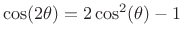 , it can be verified that
 |
(4.47) |
for
 .
The following properties of the Chebyshev polynomials are well known:
.
The following properties of the Chebyshev polynomials are well known:
 is an
th-order polynomial in
is an
th-order polynomial in  .
.
-
is an even function when
is an even integer,
and odd when
is odd.
-
has
zeros in the open interval
 , and
, and
 extrema in the closed interval
 ![$ [-1,1]$](http://www.dsprelated.com/josimages_new/sasp2/img543.png) .
.
 for
for  .
.
Dolph-Chebyshev Window Definition
Let
denote the desired window length. Then the zero-phase
Dolph-Chebyshev window is defined in the frequency domain by
[155]
![$\displaystyle W(\omega) = \frac{T_{M-1}[x_0 \cos(\omega/2)]}{T_{M-1}(x_0)}$](http://www.dsprelated.com/josimages_new/sasp2/img546.png) |
(4.48) |
where
 is defined by the desired ripple specification:
 |
(4.49) |
where
is the ``main lobe edge frequency'' defined by
![$\displaystyle \omega_c \isdefs 2\cos^{-1}\left[\frac{1}{x_0}\right].$](http://www.dsprelated.com/josimages_new/sasp2/img549.png) |
(4.50) |
Expanding
 in terms of complex exponentials yields
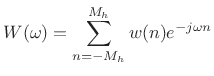 |
(4.51) |
where
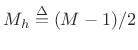 . Thus, the coefficients
give the
length
Dolph-Chebyshev window in zero-phase form.
. Thus, the coefficients
give the
length
Dolph-Chebyshev window in zero-phase form.
Dolph-Chebyshev Window Main-Lobe Width
Given the window length
and ripple magnitude  , the main-lobe
width
may be computed as follows [155]:
, the main-lobe
width
may be computed as follows [155]:
![\begin{eqnarray*}
x_0 &=& \cosh\left[\frac{\cosh^{-1}\left(\frac{1}{r}\right)}{M-1}\right]\\
\omega_c &=& 2\cos^{-1}\left(\frac{1}{x_0}\right)
\end{eqnarray*}](http://www.dsprelated.com/josimages_new/sasp2/img553.png)
This is the smallest main-lobe width possible for the given window length and side-lobe spec.
Dolph-Chebyshev Window Length Computation
Given a prescribed side-lobe ripple-magnitude
and main-lobe width
, the required window length
is given by [155]
![$\displaystyle M = 1 + \frac{\cosh^{-1}(1/r)}{\cosh^{-1}[\sec(\omega_c/2)]}.$](http://www.dsprelated.com/josimages_new/sasp2/img554.png) |
(4.52) |
For
 (the typical case), the denominator is close to
 , and we have
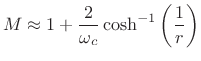 |
(4.53) |
Thus, half the time-bandwidth product in radians is approximately
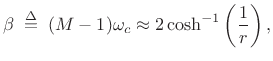 |
(4.54) |
where
 is the parameter often used to design Kaiser windows
(§3.9).
is the parameter often used to design Kaiser windows
(§3.9).
Next Section:
Gaussian Window and Transform
Previous Section:
Kaiser Window