Downsampling and Aliasing
The downsampling operator
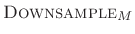 selects every
  sample of a signal:
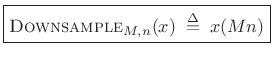 |
(3.32) |
The aliasing theorem states that downsampling in time corresponds to aliasing in the frequency domain:
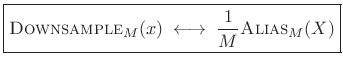 |
(3.33) |
where the
 operator is defined as
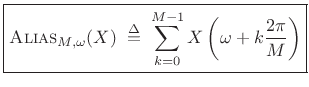 |
(3.34) |
for
 . The summation terms for
  are called aliasing components.
In z transform notation, the
operator can be expressed as
[287]
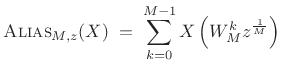 |
(3.35) |
where
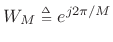 is a common notation for the primitive
 th root of unity. On the unit circle of the
  plane, this becomes
![$\displaystyle \hbox{\sc Alias}_{M,\omega}(X) \eqsp \sum_{k=0}^{M-1} X\left[e^{j\left(\frac{\omega}{M} + k\frac{2\pi}{M}\right)}\right], \quad -\pi\leq \omega < \pi.$](http://www.dsprelated.com/josimages_new/sasp2/img219.png) |
(3.36) |
The frequency scaling corresponds to having a sampling interval of
 after downsampling, which corresponds to the interval
  prior to downsampling.
The aliasing theorem makes it clear that, in order to downsample by
factor
without aliasing, we must first lowpass-filter the spectrum
to
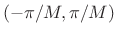 . This filtering (when ideal) zeroes out the
spectral regions which alias upon downsampling.
. This filtering (when ideal) zeroes out the
spectral regions which alias upon downsampling.
Note that any rational sampling-rate conversion factor
 may be implemented as an upsampling by the factor
  followed by
downsampling by the factor
[50,287].
Conceptually, a stretch-by-
is followed by a lowpass filter cutting
off at
followed by
downsampling by the factor
[50,287].
Conceptually, a stretch-by-
is followed by a lowpass filter cutting
off at
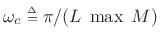 , followed by
downsample-by-
, i.e.,
, followed by
downsample-by-
, i.e.,
![$\displaystyle x^\prime \eqsp \hbox{\sc Downsample}_M\{\hbox{\sc Lowpass}_{\omega_c}[\hbox{\sc Stretch}_L(x)]\}$](http://www.dsprelated.com/josimages_new/sasp2/img225.png) |
(3.37) |
In practice, there are more efficient algorithms for sampling-rate conversion [270,135,78] based on a more direct approach to bandlimited interpolation.
Proof of Aliasing Theorem
To show:
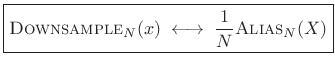
or
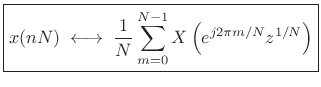
From the DFT case [264], we know this is true when  and
and  are each complex sequences of length
  , in which case
  and
and  are length
  . Thus,
 |
(3.38) |
where we have chosen to keep frequency samples
 in terms of
the original frequency axis prior to downsampling, i.e.,
in terms of
the original frequency axis prior to downsampling, i.e.,
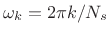 for both
and
. This choice allows us to easily take
the limit as
for both
and
. This choice allows us to easily take
the limit as
 by simply replacing
by
by simply replacing
by  :
:
 |
(3.39) |
Replacing
by
 and converting to
-transform
notation
and converting to
-transform
notation  instead of Fourier transform notation
  ,
with
,
with
 , yields the final result.
Next Section:
Differentiation Theorem Dual
Previous Section:
Stretch/Repeat (Scaling) Theorem