







Expected Value
Definition:
The expected value of a continuous random variable
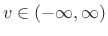 is denoted
  and is defined by
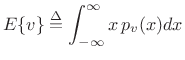 |
(C.12) |
where
 denotes the probability density function (PDF)
for the random variable v.
denotes the probability density function (PDF)
for the random variable v.
Example:
Let the random variable  be uniformly distributed between
 and
and  , i.e.,
![$\displaystyle p_v(x) = \left\{\begin{array}{ll} \frac{1}{b-a}, & a\leq x \leq b \\ [5pt] 0, & \hbox{otherwise}. \\ \end{array} \right.$](http://www.dsprelated.com/josimages_new/sasp2/img2645.png) |
(C.13) |
Then the expected value of
is computed as
 |
(C.14) |
Thus, the expected value of a random variable uniformly distributed between
and
is simply the average of
and
.
For a stochastic process, which is simply a sequence of random
variables,  means the expected value of
  over
``all realizations'' of the random process
over
``all realizations'' of the random process  . This is also
called an ensemble average. In other words, for each ``roll of
the dice,'' we obtain an entire signal
. This is also
called an ensemble average. In other words, for each ``roll of
the dice,'' we obtain an entire signal
 , and to compute
  , say, we average
together all of the values of
, say, we average
together all of the values of  obtained for all ``dice rolls.''
For a stationary random process
 , the random variables
which make it up
are identically distributed. As a result, we may normally compute
expected values by averaging over time within a single
realization of the random process, instead of having to average
``vertically'' at a single time instant over many realizations of the
random process.C.2 Denote time averaging by
, the random variables
which make it up
are identically distributed. As a result, we may normally compute
expected values by averaging over time within a single
realization of the random process, instead of having to average
``vertically'' at a single time instant over many realizations of the
random process.C.2 Denote time averaging by
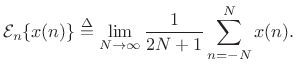 |
(C.15) |
Then, for a stationary random processes, we have
 . That is, for stationary random
signals, ensemble averages equal time averages.
. That is, for stationary random
signals, ensemble averages equal time averages.
We are concerned only with stationary stochastic processes in this book. While the statistics of noise-like signals must be allowed to evolve over time in high quality spectral models, we may require essentially time-invariant statistics within a single frame of data in the time domain. In practice, we choose our spectrum analysis window short enough to impose this. For audio work, 20 ms is a typical choice for a frequency-independent frame length.C.3 In a multiresolution system, in which the frame length can vary across frequency bands, several periods of the band center-frequency is a reasonable choice. As discussed in §5.5.2, the minimum number of periods required under the window for resolution of spectral peaks depends on the window type used.
Next Section:
Mean
Previous Section:
Stationary Stochastic Process












