







Fourier Transforms for Continuous/Discrete Time/Frequency
The Fourier transform can be defined for signals which are
- discrete or continuous in time, and
- finite or infinite in duration.
- discrete or continuous in frequency, and
- finite or infinite in bandwidth.
Reference [264] develops the DFT in detail--the discrete-time, discrete-frequency case. In the DFT, both the time and frequency axes are finite in length.
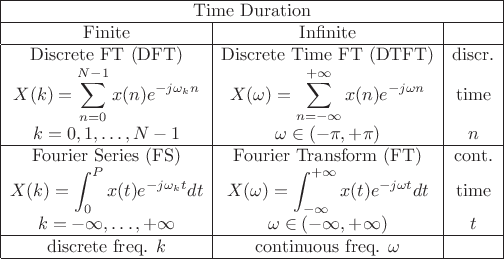
Table 2.1 (next page) summarizes the four Fourier-transform cases corresponding to discrete or continuous time and/or frequency.
 |
 .)
.)
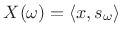
In all four cases, the Fourier transform can be interpreted as
the inner product of the signal  with a complex sinusoid at
radian frequency
with a complex sinusoid at
radian frequency  [264]:
 |
(3.1) |
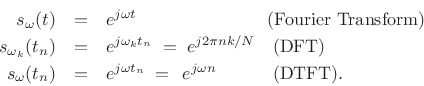
where
 is appropriately adapted, e.g.,
In spectral modeling of audio, we usually deal with indefinitely long signals. Fourier analysis of an indefinitely long discrete-time signal is carried out using the Discrete Time Fourier Transform (DTFT).3.1Below, the DTFT is defined, and selected Fourier theorems are stated and proved for the DTFT case. Additionally, for completeness, the Fourier Transform (FT) is defined, and selected FT theorems are stated and proved as well. Theorems for the DFT case are detailed in [264].3.2
Discrete Time Fourier Transform (DTFT)
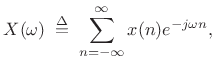
The Discrete Time Fourier Transform (DTFT) can be viewed as the
limiting form of the DFT when its length  is allowed to approach
infinity:
is allowed to approach
infinity:
 |
(3.2) |
where
 denotes the continuous radian
frequency variable,3.3 and
denotes the continuous radian
frequency variable,3.3 and  is the signal amplitude at
sample number
is the signal amplitude at
sample number  .
.
The inverse DTFT is
 |
(3.3) |
which can be derived in a manner analogous to the derivation of the inverse DFT [264].
Instead of operating on sampled signals of length
(like the DFT),
the DTFT operates on sampled signals
defined over all integers
 .
.
Unlike the DFT, the DTFT frequencies form a continuum. That
is, the DTFT is a function of continuous frequency
, while the DFT is a function of discrete
frequency  ,
,
![$ k\in[0,N-1]$](http://www.dsprelated.com/josimages_new/sasp2/img101.png) . The DFT frequencies
. The DFT frequencies
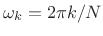 ,
,
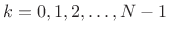 , are given by the angles of
points
uniformly distributed along the unit circle in the complex
plane. Thus, as
, are given by the angles of
points
uniformly distributed along the unit circle in the complex
plane. Thus, as
 , a continuous
frequency axis must result in the limit along the unit circle. The
axis is still finite in length, however, because the time domain
remains sampled.
, a continuous
frequency axis must result in the limit along the unit circle. The
axis is still finite in length, however, because the time domain
remains sampled.
Fourier Transform (FT) and Inverse
The Fourier transform of a signal
 ,
,
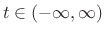 , is defined as
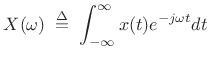
and its inverse is given by
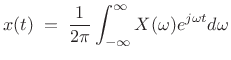
Thus, the Fourier transform is defined for continuous time and continuous frequency, both unbounded. As a result, mathematical questions such as existence and invertibility are most difficult for this case. In fact, such questions fueled decades of confusion in the history of harmonic analysis (see Appendix G).
Existence of the Fourier Transform
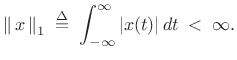
Conditions for the existence of the Fourier transform are
complicated to state in general [36], but it is sufficient
for  to be absolutely integrable, i.e.,
 |
(3.6) |
This requirement can be stated as
 , meaning that
belongs to the set of all signals having a finite
, meaning that
belongs to the set of all signals having a finite  norm
(
norm
(
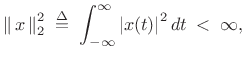
 ). It is similarly sufficient for
to be
square integrable, i.e.,
). It is similarly sufficient for
to be
square integrable, i.e.,
 |
(3.7) |
or,
 . More generally, it suffices to show
  for
for
 [36, p. 47].
There is never a question of existence, of course, for Fourier transforms of real-world signals encountered in practice. However, idealized signals, such as sinusoids that go on forever in time, do pose normalization difficulties. In practical engineering analysis, these difficulties are resolved using Dirac's ``generalized functions'' such as the impulse (also loosely called the delta function), discussed in §B.10.
Fourier Theorems for the DTFT
This section states and proves selected Fourier theorems for the DTFT. A more complete list for the DFT case is given in [264].3.4Since this material was originally part of an appendix, it is relatively dry reading. Feel free to skip to the next chapter and refer back as desired when a theorem is invoked.
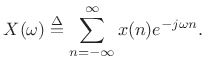
As introduced in §2.1 above, the Discrete-Time Fourier Transform (DTFT) may be defined as
 |
(3.8) |
We say that
 is the spectrum of
.
is the spectrum of
.
Linearity of the DTFT
 |
(3.9) |
or
 |
(3.10) |
where
 are any scalars (real or complex
numbers),
are any scalars (real or complex
numbers),  and
and  are any two discrete-time signals
(real- or complex-valued functions of the integers), and
are any two discrete-time signals
(real- or complex-valued functions of the integers), and  are their corresponding continuous-frequency spectra defined
over the unit circle in the complex plane.
are their corresponding continuous-frequency spectra defined
over the unit circle in the complex plane.
Proof:
We have
![\begin{eqnarray*}
\hbox{\sc DTFT}_\omega(\alpha x_1 + \beta x_2)
& \isdef & \sum_{n=-\infty}^{\infty}[\alpha x_1(n) + \beta x_2(n)]e^{-j\omega n}\\
&=& \alpha\sum_{n=-\infty}^{\infty}x_1(n)e^{-j\omega n} + \beta \sum_{n=-\infty}^{\infty}x_2(n)e^{-j\omega n}\\
&\isdef & \alpha X_1(\omega) + \beta X_2(\omega)
\end{eqnarray*}](http://www.dsprelated.com/josimages_new/sasp2/img126.png)
One way to describe the linearity property is to observe that the Fourier transform ``commutes with mixing.''
Time Reversal
For any complex signal
,
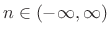 , we have
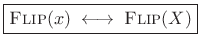 |
(3.11) |
where
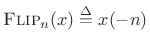 .
.
Proof:
![\begin{eqnarray*}
\hbox{\sc DTFT}_\omega(\hbox{\sc Flip}(x))
&\isdef & \sum_{n=-\infty}^{\infty} x(-n)e^{-j\omega n}
\eqsp \sum_{m=\infty}^{-\infty} x(m)e^{-j(-\omega) m}
\eqsp X(-\omega) \\ [5pt]
&\isdef & \hbox{\sc Flip}_\omega(X)
\end{eqnarray*}](http://www.dsprelated.com/josimages_new/sasp2/img130.png)
Arguably,
 should include complex conjugation. Let
 |
(3.12) |
denote such a definition. Then in this case we have
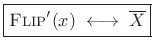 |
(3.13) |
Proof:
 |
(3.14) |
In the typical special case of real signals (
 ), we have
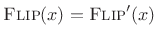 so that
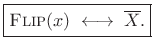 |
(3.15) |
That is, time-reversing a real signal conjugates its spectrum.
Symmetry of the DTFT for Real Signals
Most (if not all) of the signals we deal with in practice are real signals. Here we note some spectral symmetries associated with real signals.
DTFT of Real Signals
The previous section established that the spectrum
of every real
signal
satisfies
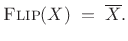 |
(3.16) |
I.e.,
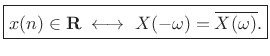 |
(3.17) |
In other terms, if a signal
is real, then its spectrum is
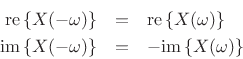
Hermitian (``conjugate symmetric''). Hermitian spectra have
the following equivalent characterizations:
- The real part is even, while the imaginary part is odd:
- The magnitude is even, while the phase is odd:
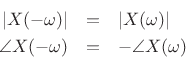
Real Even (or Odd) Signals
If a signal is even in addition to being real, then its DTFT is also real and even. This follows immediately from the Hermitian symmetry of real signals, and the fact that the DTFT of any even signal is real:
![\begin{eqnarray*}
\hbox{\sc DTFT}_\omega(x)
& \isdef & \sum_{n=-\infty}^{\infty}x(n) e^{-j\omega n}\\
& = & \sum_{n=-\infty}^{\infty}x(n) \left[\cos(\omega n) + j\sin(\omega n)\right]\\
& = & \sum_{n=-\infty}^{\infty}x(n) \cos(\omega n) + j\sum_{n=-\infty}^{\infty}x(n)\sin(\omega n)\\
& = & \sum_{n=-\infty}^{\infty}x(n) \cos(\omega n)\\
& = & \hbox{real and even}
\end{eqnarray*}](http://www.dsprelated.com/josimages_new/sasp2/img142.png)
This is true since cosine is even, sine is odd, even times even is even, even times odd is odd, and the sum over all samples of an odd signal is zero. I.e.,
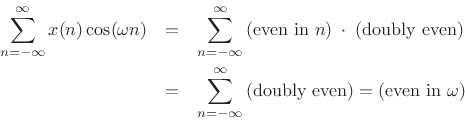
and
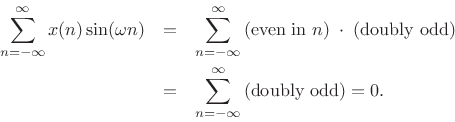
If
is real and even, the following are true:
![\begin{eqnarray*}
\hbox{\sc Flip}(x) & = & x \qquad \hbox{($x(-n)=x(n)$)}\\
\overline{x} & = & x\\ [5pt]
\hbox{\sc Flip}(X) & = & X\\
\overline{X} & = & X\\
\angle X(\omega) & =& 0 \hbox{ or } \pi
\end{eqnarray*}](http://www.dsprelated.com/josimages_new/sasp2/img145.png)
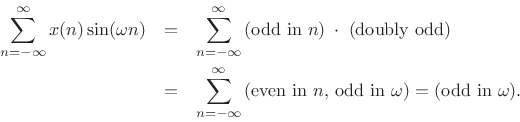
Similarly, if a signal is odd and real, then its DTFT is odd and purely imaginary. This follows from Hermitian symmetry for real signals, and the fact that the DTFT of any odd signal is imaginary.
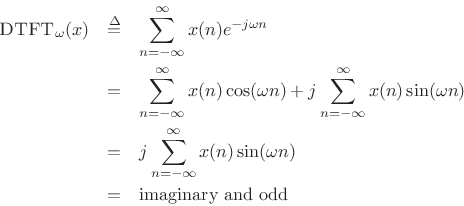
where we used the fact that
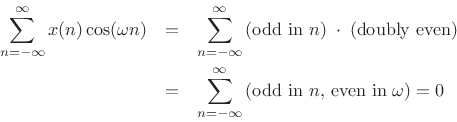
and
Shift Theorem for the DTFT
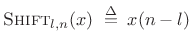
We define the shift operator for sampled signals
by
 |
(3.18) |
where
 is any integer (
 ). Thus,
 is a
right-shift or delay by
samples.
is a
right-shift or delay by
samples.
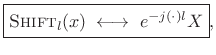
The shift theorem states3.5
 |
(3.19) |
or, in operator notation,
![$\displaystyle \hbox{\sc DTFT}_\omega[\hbox{\sc Shift}_l(x)] \eqsp \left( e^{-j\omega l} \right) X(\omega)$](http://www.dsprelated.com/josimages_new/sasp2/img157.png) |
(3.20) |
Proof:
![\begin{eqnarray*}
\hbox{\sc DTFT}_\omega[\hbox{\sc Shift}_l(x)] &\isdef & \sum_{n=-\infty}^{\infty}x(n-l) e^{-j \omega n} \\
&=& \sum_{m=-\infty}^{\infty} x(m) e^{-j \omega (m+l)}
\qquad(m\isdef n-l) \\
&=& \sum_{m=-\infty}^{\infty}x(m) e^{-j \omega m} e^{-j \omega l} \\
&=& e^{-j \omega l} \sum_{m=-\infty}^{\infty}x(m) e^{-j \omega m} \\
&\isdef & e^{-j \omega l} X(\omega)
\end{eqnarray*}](http://www.dsprelated.com/josimages_new/sasp2/img158.png)
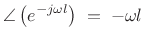
Note that
 is a linear phase term, so called
because it is a linear function of frequency with slope equal to
is a linear phase term, so called
because it is a linear function of frequency with slope equal to  :
:
 |
(3.21) |
The shift theorem gives us that multiplying a spectrum
 by
a linear phase term
corresponds to a delay in
the time domain by
samples. If
by
a linear phase term
corresponds to a delay in
the time domain by
samples. If  , it is called a time
advance by
, it is called a time
advance by  samples.
Convolution Theorem for the DTFT
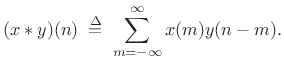
The convolution of discrete-time signals
and  is defined
as
is defined
as
 |
(3.22) |
This is sometimes called acyclic convolution to distinguish it from the cyclic convolution used for length
sequences in
the context of the DFT [264]. Convolution is cyclic in the time
domain for the DFT and FS cases (i.e., whenever the time domain has a
finite length), and acyclic for the DTFT and FT cases.3.6
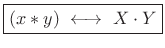
The convolution theorem is then
 |
(3.23) |
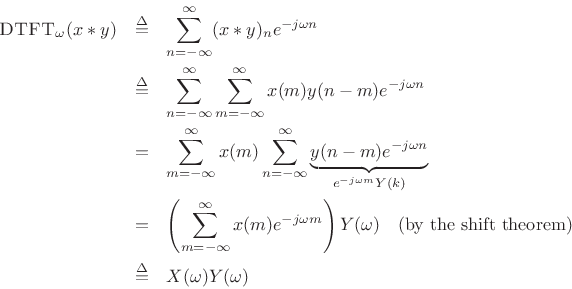
That is, convolution in the time domain corresponds to pointwise multiplication in the frequency domain.
Proof: The result follows immediately from interchanging the order
of summations associated with the convolution and DTFT:
Correlation Theorem for the DTFT
We define the correlation of discrete-time signals
and
by
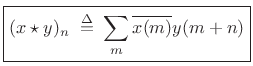
The correlation theorem for DTFTs is then

Proof:
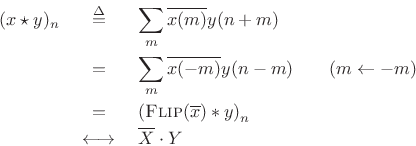
where the last step follows from the convolution theorem of
§2.3.5 and the symmetry result
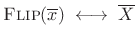 of §2.3.2.
Autocorrelation
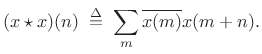
The autocorrelation of a signal
is simply the
cross-correlation of
with itself:
 |
(3.24) |
From the correlation theorem, we have
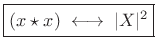
Note that this definition of autocorrelation is appropriate for signals having finite support (nonzero over a finite number of samples). For infinite-energy (but finite-power) signals, such as stationary noise processes, we define the sample autocorrelation to include a normalization suitable for this case (see Chapter 6 and Appendix C).
From the autocorrelation theorem we have that a digital-filter
impulse-response  is that of a lossless allpass filter
[263] if and only if
is that of a lossless allpass filter
[263] if and only if
 .
In other words, the autocorrelation of the impulse-response of every
allpass filter is impulsive.
.
In other words, the autocorrelation of the impulse-response of every
allpass filter is impulsive.
Power Theorem for the DTFT
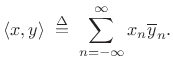
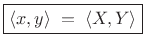
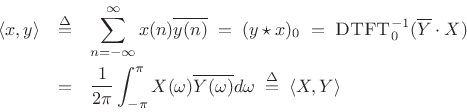
The inner product of two signals may be defined in the time domain by [264]
 |
(3.25) |
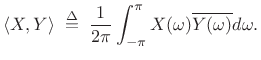
The inner product of two spectra may be defined as
 |
(3.26) |
Note that the frequency-domain inner product includes a normalization factor while the time-domain definition does not.
Using inner-product notation, the power theorem (or Parseval's theorem [202]) for DTFTs can be stated as follows:
 |
(3.27) |
That is, the inner product of two signals in the time domain equals the inner product of their respective spectra (a complex scalar in general).
When we consider the inner product of a signal with itself, we have the special case known as the energy theorem (or Rayleigh's energy theorem):
 |
(3.28) |
where
 denotes the
  norm induced by the inner
product. It is always real.
norm induced by the inner
product. It is always real.
Proof:
Stretch Operator
We define the stretch operator in the time domain by
![$\displaystyle \hbox{\sc Stretch}_{L,n}(x) \isdefs \left\{\begin{array}{ll} x\left(\frac{n}{L}\right), & n = 0\;(\hbox{\sc mod}\ L) \\ [5pt] 0, & \hbox{otherwise} \\ \end{array} \right..$](http://www.dsprelated.com/josimages_new/sasp2/img183.png) |
(3.29) |
In other terms, we stretch a sampled signal by the factor
 by
inserting
by
inserting  zeros in between each pair of samples of the
signal.
zeros in between each pair of samples of the
signal.
![\includegraphics[width=4in]{eps/stretch2}](http://www.dsprelated.com/josimages_new/sasp2/img186.png)
In the literature on multirate filter banks (see Chapter 11), the
stretch operator is typically called instead the upsampling
operator. That is, stretching a signal by the factor of  is called
upsampling the signal by the factor
. (See §11.1.1 for
the graphical symbol (
is called
upsampling the signal by the factor
. (See §11.1.1 for
the graphical symbol (
 ) and associated discussion.) The
term ``stretch'' is preferred in this book because ``upsampling''
is easily confused with ``increasing the sampling rate''; resampling a
signal to a higher sampling rate is conceptually implemented by a
stretch operation followed by an ideal lowpass filter which moves the
inserted zeros to their properly interpolated values.
) and associated discussion.) The
term ``stretch'' is preferred in this book because ``upsampling''
is easily confused with ``increasing the sampling rate''; resampling a
signal to a higher sampling rate is conceptually implemented by a
stretch operation followed by an ideal lowpass filter which moves the
inserted zeros to their properly interpolated values.
Note that we could also call the stretch operator the scaling operator, to unify the terminology in the discrete-time case with that of the continuous-time case (§2.4.1 below).
Repeat (Scaling) Operator
We define the repeat operator in the frequency domain as
a scaling of frequency axis by some integer factor  :
:
 |
(3.30) |
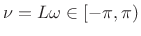
where
 denotes the radian frequency variable after
applying the repeat operator.
denotes the radian frequency variable after
applying the repeat operator.
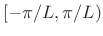
The repeat operator maps the entire unit circle (taken as  to
to
 ) to a segment of itself
 , centered about
 , and repeated
times. This is illustrated in Fig.2.2
for
, and repeated
times. This is illustrated in Fig.2.2
for  .
.
![\begin{psfrags}
% latex2html id marker 7156\psfrag{w}{\Large $\omega$}\begin{figure}[htbp]
\includegraphics[width=\twidth]{eps/repeat2}
\caption{Illustration of the repeat operator.}
\end{figure}
\end{psfrags}](http://www.dsprelated.com/josimages_new/sasp2/img196.png)
Since the frequency axis is continuous and  -periodic for DTFTs,
the repeat operator is precisely equivalent to a scaling operator for
the Fourier transform case (§B.4). We call it ``repeat''
rather than ``scale'' because we are restricting the scale factor to
positive integers, and because the name ``repeat'' describes more
vividly what happens to a periodic spectrum that is compressively
frequency-scaled over the unit circle by an integer factor.
-periodic for DTFTs,
the repeat operator is precisely equivalent to a scaling operator for
the Fourier transform case (§B.4). We call it ``repeat''
rather than ``scale'' because we are restricting the scale factor to
positive integers, and because the name ``repeat'' describes more
vividly what happens to a periodic spectrum that is compressively
frequency-scaled over the unit circle by an integer factor.
Stretch/Repeat (Scaling) Theorem
Using these definitions, we can compactly state the stretch theorem:
 |
(3.31) |
Proof:
![\begin{eqnarray*}
\hbox{\sc DTFT}_\omega[\hbox{\sc Stretch}_L(x)]
&\isdef & \sum_{n=-\infty}^{\infty}\hbox{\sc Stretch}_{L,n}(x)e^{-j\omega n}\\
&=& \sum_{m=-\infty}^{\infty}x(m)e^{-j\omega m L}\qquad \hbox{($m\isdef n/L$)}\\
&\isdef & X(\omega L)
\end{eqnarray*}](http://www.dsprelated.com/josimages_new/sasp2/img199.png)
As
traverses the interval
 ,
,
 traverses the unit circle
times, thus implementing the repeat
operation on the unit circle. Note also that when
, we have
traverses the unit circle
times, thus implementing the repeat
operation on the unit circle. Note also that when
, we have
 , so that dc always maps to dc. At half the sampling
rate
, so that dc always maps to dc. At half the sampling
rate
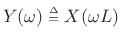
 , on the other hand, after the mapping, we may have
either
, on the other hand, after the mapping, we may have
either
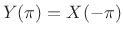 (
odd), or
(
odd), or  (
even), where
(
even), where
 .
.
The stretch theorem makes it clear how to do
ideal sampling-rate conversion for integer upsampling ratios
:
We first stretch the signal by the factor
(introducing
zeros
between each pair of samples), followed by an ideal lowpass
filter cutting off at  . That is, the filter has a gain of 1
for
. That is, the filter has a gain of 1
for
 , and a gain of 0 for
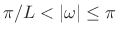 . Such a system (if it were realizable) implements ideal bandlimited interpolation of the original signal by the factor
.
. Such a system (if it were realizable) implements ideal bandlimited interpolation of the original signal by the factor
.
The stretch theorem is analogous to the scaling theorem for continuous Fourier transforms (introduced in §2.4.1 below).
Downsampling and Aliasing
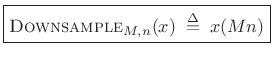
The downsampling operator
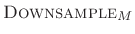 selects every
  sample of a signal:
 |
(3.32) |
The aliasing theorem states that downsampling in time corresponds to aliasing in the frequency domain:
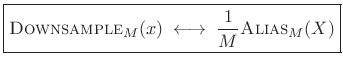 |
(3.33) |
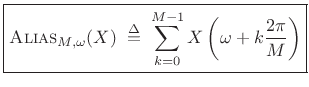
where the
 operator is defined as
 |
(3.34) |
for
. The summation terms for  are called aliasing components.
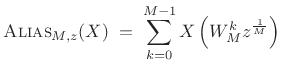
In z transform notation, the
operator can be expressed as
[287]
 |
(3.35) |
where
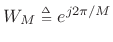 is a common notation for the primitive
 th root of unity. On the unit circle of the
  plane, this becomes
![$\displaystyle \hbox{\sc Alias}_{M,\omega}(X) \eqsp \sum_{k=0}^{M-1} X\left[e^{j\left(\frac{\omega}{M} + k\frac{2\pi}{M}\right)}\right], \quad -\pi\leq \omega < \pi.$](http://www.dsprelated.com/josimages_new/sasp2/img219.png) |
(3.36) |
The frequency scaling corresponds to having a sampling interval of
 after downsampling, which corresponds to the interval
  prior to downsampling.
The aliasing theorem makes it clear that, in order to downsample by
factor
without aliasing, we must first lowpass-filter the spectrum
to
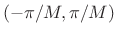 . This filtering (when ideal) zeroes out the
spectral regions which alias upon downsampling.
. This filtering (when ideal) zeroes out the
spectral regions which alias upon downsampling.
Note that any rational sampling-rate conversion factor
 may be implemented as an upsampling by the factor
followed by
downsampling by the factor
[50,287].
Conceptually, a stretch-by-
is followed by a lowpass filter cutting
off at
may be implemented as an upsampling by the factor
followed by
downsampling by the factor
[50,287].
Conceptually, a stretch-by-
is followed by a lowpass filter cutting
off at
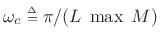 , followed by
downsample-by-
, i.e.,
, followed by
downsample-by-
, i.e.,
![$\displaystyle x^\prime \eqsp \hbox{\sc Downsample}_M\{\hbox{\sc Lowpass}_{\omega_c}[\hbox{\sc Stretch}_L(x)]\}$](http://www.dsprelated.com/josimages_new/sasp2/img225.png) |
(3.37) |
In practice, there are more efficient algorithms for sampling-rate conversion [270,135,78] based on a more direct approach to bandlimited interpolation.
Proof of Aliasing Theorem
To show:
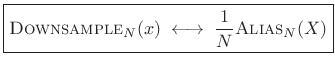
or
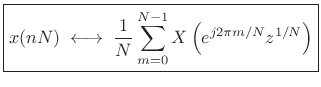
From the DFT case [264], we know this is true when
and
are each complex sequences of length  , in which case
and
, in which case
and  are length
  . Thus,
 |
(3.38) |
where we have chosen to keep frequency samples
in terms of
the original frequency axis prior to downsampling, i.e.,
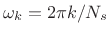 for both
and
. This choice allows us to easily take
the limit as
for both
and
. This choice allows us to easily take
the limit as
 by simply replacing
by
:
by simply replacing
by
:
 |
(3.39) |
Replacing
by
 and converting to
-transform
notation
and converting to
-transform
notation  instead of Fourier transform notation
,
with
instead of Fourier transform notation
,
with
 , yields the final result.
Differentiation Theorem Dual
Theorem: Let
denote a signal with DTFT
 , and let
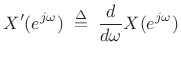 |
(3.40) |
denote the derivative of
with respect to
.
Then we have
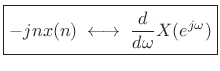
where
denotes the DTFT of
.
Proof:
Using integration by parts, we obtain
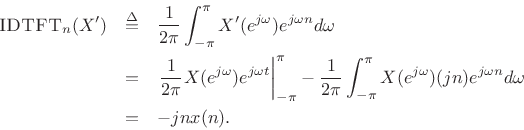
An alternate method of proof is given in §B.3.
Corollary: Perhaps a cleaner statement is as follows:

This completes our coverage of selected DTFT theorems. The next section adds some especially useful FT theorems having no precise counterpart in the DTFT (discrete-time) case.
Continuous-Time Fourier Theorems
Selected Fourier theorems for the continuous-time case are stated and proved in Appendix B. However, two are sufficiently important that we state them here.
Scaling Theorem
The scaling theorem (or similarity theorem) says that if
you horizontally ``stretch'' a signal by the factor  in the
time domain, you ``squeeze'' and amplify its Fourier transform by the
same factor in the frequency domain. This is an important general
Fourier duality relationship:
in the
time domain, you ``squeeze'' and amplify its Fourier transform by the
same factor in the frequency domain. This is an important general
Fourier duality relationship:
Theorem: For all continuous-time functions
possessing a Fourier
transform,

where
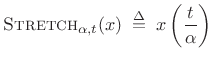
and
is any nonzero real number (the abscissa stretch factor).
A more commonly used notation is the following:
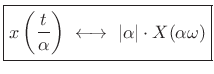 |
(3.41) |
Proof: See §B.4.
The scaling theorem is fundamentally restricted to the
continuous-time, continuous-frequency (Fourier transform) case. The
closest we come to the scaling theorem among the DTFT theorems
(§2.3) is the stretch (repeat) theorem
(page ![[*]](../icons/crossref.png) ). For this and other continuous-time Fourier
theorems, see Appendix B.
). For this and other continuous-time Fourier
theorems, see Appendix B.
Spectral Roll-Off
Definition: A function  is said to be of order
 if
there exist
if
there exist  and some positive constant
  such
that
such
that
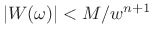 for all
 .
.
Theorem: (Riemann Lemma):
If the derivatives up to order
of a function  exist and are
of bounded variation, then its Fourier Transform
is
asymptotically of order
, i.e.,
exist and are
of bounded variation, then its Fourier Transform
is
asymptotically of order
, i.e.,
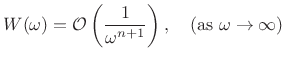 |
(3.42) |
Proof: See §B.18.
Spectral Interpolation
The need for spectral interpolation comes up in many situations. For example, we always use the DFT in practice, while conceptually we often prefer the DTFT. For time-limited signals, that is, signals which are zero outside some finite range, the DTFT can be computed from the DFT via spectral interpolation. Conversely, the DTFT of a time-limited signal can be sampled to obtain its DFT.3.7Another application of DFT interpolation is spectral peak estimation, which we take up in Chapter 5; in this situation, we start with a sampled spectral peak from a DFT, and we use interpolation to estimate the frequency of the peak more accurately than what we get by rounding to the nearest DFT bin frequency.
The following sections describe the theoretical and practical details of ideal spectral interpolation.
Ideal Spectral Interpolation
Ideally, the spectrum of any signal
at any frequency
 is obtained by projecting the signal
onto the
zero-phase, unit-amplitude, complex sinusoid at frequency
[264]:
is obtained by projecting the signal
onto the
zero-phase, unit-amplitude, complex sinusoid at frequency
[264]:
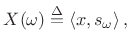 |
(3.43) |
where
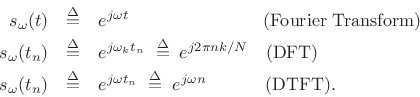
Thus, for signals in the DTFT domain which are time limited to
![$ n\in[-N/2,N/2-1]$](http://www.dsprelated.com/josimages_new/sasp2/img257.png) ,
we obtain
,
we obtain
 |
(3.44) |
This can be thought of as a zero-centered DFT evaluated at
instead of
for some
. It arises naturally from taking the DTFT of a
finite-length signal. Such time-limited signals may be said to have
``finite support'' [175].
Interpolating a DFT
Starting with a sampled spectrum
 ,
,
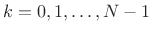 ,
typically obtained from a DFT, we can interpolate by taking the DTFT
of the IDFT which is not periodically extended, but instead
zero-padded [264]:3.8
,
typically obtained from a DFT, we can interpolate by taking the DTFT
of the IDFT which is not periodically extended, but instead
zero-padded [264]:3.8
![\begin{eqnarray*}
X(\omega) &=& \hbox{\sc DTFT}(\hbox{\sc ZeroPad}_{\infty}(\hbox{\sc IDFT}_N(X)))\\
&\isdef & \sum_{n=-N/2}^{N/2-1}\left[\frac{1}{N}\sum_{k=0}^{N-1}X(\omega_k)
e^{j\omega_k n}\right]e^{-j\omega n}\\
&=& \sum_{k=0}^{N-1}X(\omega_k)
\left[\frac{1}{N}\sum_{n=-N/2}^{N/2-1} e^{j(\omega_k-\omega) n}\right]\\
&=& \sum_{k=0}^{N-1}X(\omega_k)\,\hbox{asinc}_N(\omega-\omega_k)\\
&=& \left<X,\hbox{\sc Sample}_N\{\hbox{\sc Shift}_{\omega}(\hbox{asinc}_N)\}\right>
\end{eqnarray*}](http://www.dsprelated.com/josimages_new/sasp2/img261.png)
(The aliased sinc function,
 , is derived in
§3.1.)
Thus, zero-padding in the time domain interpolates a spectrum
consisting of
samples around the unit circle by means of ``
, is derived in
§3.1.)
Thus, zero-padding in the time domain interpolates a spectrum
consisting of
samples around the unit circle by means of ``
 interpolation.'' This is ideal,
time-limited interpolation
in the frequency domain using the
aliased sinc function as an interpolation kernel. We can almost
rewrite the last line above as
interpolation.'' This is ideal,
time-limited interpolation
in the frequency domain using the
aliased sinc function as an interpolation kernel. We can almost
rewrite the last line above as
 ,
but such an expression would normally be defined only for
,
but such an expression would normally be defined only for
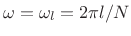 , where
is some integer, since
is
discrete while
is continuous.
, where
is some integer, since
is
discrete while
is continuous.
Figure F.1 lists a matlab function for performing ideal spectral interpolation directly in the frequency domain. Such an approach is normally only used when non-uniform sampling of the frequency axis is needed. For uniform spectral upsampling, it is more typical to take an inverse FFT, zero pad, then a longer FFT, as discussed further in the next section.
Zero Padding in the Time Domain
Unlike time-domain interpolation [270], ideal spectral interpolation is very easy to implement in practice by means of zero padding in the time domain. That is,
Since the frequency axis (the unit circle in the
plane) is finite
in length, ideal interpolation can be implemented exactly to
within numerical round-off error. This is quite different from ideal
(band-limited) time-domain interpolation, in which the interpolation
kernel is
sinc ; the
sinc
function extends to plus and
minus infinity in time, so it can never be implemented exactly in
practice.3.9
; the
sinc
function extends to plus and
minus infinity in time, so it can never be implemented exactly in
practice.3.9
Practical Zero Padding
To interpolate a uniformly sampled spectrum
,
by the factor
, we may take the length
inverse DFT, append
 zeros to the time-domain data, and take
a length
zeros to the time-domain data, and take
a length  DFT. If
is a power of two, then so is
and
we can use a Cooley-Tukey FFT for both steps (which is very fast):
DFT. If
is a power of two, then so is
and
we can use a Cooley-Tukey FFT for both steps (which is very fast):
 |
(3.45) |
This operation creates
new bins between each pair of original
bins in
, thus increasing the number of spectral samples around the
unit circle from
to  . An example for
  is shown in
Fig.2.4 (compare to Fig.2.3).
is shown in
Fig.2.4 (compare to Fig.2.3).
In matlab, we can specify zero-padding by simply providing the optional FFT-size argument:
X = fft(x,N); % FFT size N > length(x)
Zero-Padding to the Next Higher Power of 2
Another reason we zero-pad is to be able to use a Cooley-Tukey FFT with any
window length
. When
is not a power of  , we append enough
zeros to make the FFT size
, we append enough
zeros to make the FFT size  be a power of
. In Matlab and
Octave, the function nextpow2 returns the next higher power
of 2 greater than or equal to its argument:
be a power of
. In Matlab and
Octave, the function nextpow2 returns the next higher power
of 2 greater than or equal to its argument:
N = 2^nextpow2(M); % smallest M-compatible FFT size
Zero-Padding for Interpolating Spectral Displays
Suppose we perform spectrum analysis on some sinusoid using a length
window. Without zero padding, the DFT length is  . We may
regard the DFT as a critically sampled DTFT (sampled in
frequency). Since the bin separation in a length-
DFT is
. We may
regard the DFT as a critically sampled DTFT (sampled in
frequency). Since the bin separation in a length-
DFT is  ,
and the zero-crossing interval for Blackman-Harris side lobes is
,
and the zero-crossing interval for Blackman-Harris side lobes is
 , we see that there is one bin per side lobe in the
sampled window transform. These spectral samples are illustrated for
a Hamming window transform in Fig.2.3b. Since
, we see that there is one bin per side lobe in the
sampled window transform. These spectral samples are illustrated for
a Hamming window transform in Fig.2.3b. Since  in
Table 5.2, the main lobe is 4 samples wide when critically
sampled. The side lobes are one sample wide, and the samples happen
to hit near some of the side-lobe zero-crossings, which could be
misleading to the untrained eye if only the samples were shown. (Note
that the plot is clipped at -60 dB.)
in
Table 5.2, the main lobe is 4 samples wide when critically
sampled. The side lobes are one sample wide, and the samples happen
to hit near some of the side-lobe zero-crossings, which could be
misleading to the untrained eye if only the samples were shown. (Note
that the plot is clipped at -60 dB.)
![\includegraphics[width=\twidth]{eps/spectsamps}](http://www.dsprelated.com/josimages_new/sasp2/img279.png) |
If we now zero pad the Hamming-window by a factor of 2
(append 21 zeros to the length  window and take an
  point
DFT), we obtain the result shown in Fig.2.4. In this case,
the main lobe is 8 samples wide, and there are two samples per side
lobe. This is significantly better for display even though there is
no new information in the spectrum relative to Fig.2.3.3.10
point
DFT), we obtain the result shown in Fig.2.4. In this case,
the main lobe is 8 samples wide, and there are two samples per side
lobe. This is significantly better for display even though there is
no new information in the spectrum relative to Fig.2.3.3.10
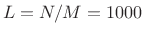
Incidentally, the solid lines in Fig.2.3b and
2.4b indicating the ``true'' DTFT were computed
using a zero-padding factor of
 , and they were virtually
indistinguishable visually from
, and they were virtually
indistinguishable visually from  . (
. ( is not enough.)
![\includegraphics[width=\twidth]{eps/spectsamps2}](http://www.dsprelated.com/josimages_new/sasp2/img285.png) |
 -oversampled sinusoidal peak =
frequency-shifted Hamming-window transform.
-oversampled sinusoidal peak =
frequency-shifted Hamming-window transform.
Zero-Padding for Interpolating Spectral Peaks
For sinusoidal peak-finding, spectral interpolation via zero-padding gets us closer to the true maximum of the main lobe when we simply take the maximum-magnitude FFT-bin as our estimate.
The examples in Fig.2.5 show how zero-padding helps in clarifying the true peak of the sampled window transform. With enough zero-padding, even very simple interpolation methods, such as quadratic polynomial interpolation, will give accurate peak estimates.
![\includegraphics[width=0.7\twidth]{eps/spectsamps3}](http://www.dsprelated.com/josimages_new/sasp2/img286.png) |
Another illustration of zero-padding appears in Section 8.1.3 of [264].
Zero-Phase Zero Padding
The previous zero-padding example used the causal Hamming window, and the appended zeros all went to the right of the window in the FFT input buffer (see Fig.2.4a). When using zero-phase FFT windows (usually the best choice), the zero-padding goes in the middle of the FFT buffer, as we now illustrate.
We look at zero-phase zero-padding using a Blackman window (§3.3.1) which has good, though suboptimal, characteristics for audio work.3.11
Figure 2.6a shows a windowed segment of some sinusoidal data,
with the window also shown as an envelope. Figure 2.6b shows
the same data loaded into an FFT input buffer with a factor of 2
zero-phase zero padding. Note that all time is ``modulo
'' for a
length
FFT. As a result, negative times  map to
  in the
FFT input buffer.
in the
FFT input buffer.
![\includegraphics[width=\twidth]{eps/zpblackmanT}](http://www.dsprelated.com/josimages_new/sasp2/img289.png) |
Figure 2.7a shows the result of performing an FFT on the data
of Fig.2.6b. Since frequency indices are also modulo
,
the negative-frequency bins appear in the right half of the
buffer. Figure 2.6b shows the same data ``rotated'' so that
bin number is in order of physical frequency from  to
to  .
If
.
If  is the bin number, then the frequency in Hz is given by
  , where
  denotes the sampling rate and
is the FFT size.
denotes the sampling rate and
is the FFT size.
![\includegraphics[width=\twidth]{eps/zpblackmanF}](http://www.dsprelated.com/josimages_new/sasp2/img293.png) |
The Matlab script for creating Figures 2.6 and 2.7 is listed in in §F.1.1.
Matlab/Octave fftshift utility
Matlab and Octave have a simple utility called fftshift that performs this bin rotation. Consider the following example:
octave:4>
fftshift([1 2 3 4])
ans =
  3  4  1  2
octave:5>
If the vector [1 2 3 4] is the output of a length 4 FFT, then the first element (1) is the dc term, and the third element (3) is the point at half the sampling rate (
), which can be taken to be
either plus or minus
since they are the same point on the
unit circle in the
plane. Elements 2 and 4 are plus and minus
 , respectively. After fftshift, element (3) is first,
which indicates that both Matlab and Octave regard the spectral sample
at half the sampling rate as a negative frequency. The next element
is 4, corresponding to frequency
, respectively. After fftshift, element (3) is first,
which indicates that both Matlab and Octave regard the spectral sample
at half the sampling rate as a negative frequency. The next element
is 4, corresponding to frequency  , followed by dc and
.
, followed by dc and
.
Another reasonable result would be fftshift([1 2 3 4]) == [4 1
2 3], which defines half the sampling rate as a positive frequency.
However, giving
to the negative frequencies balances giving dc
to the positive frequencies, and the number of samples on both sides
is then the same. For an odd-length DFT, there is no point at
 , so the result
octave:4>
fftshift([1 2 3])
ans =
  3  1  2
octave:5>
is the only reasonable answer, corresponding to frequencies
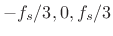 , respectively.
Index Ranges for Zero-Phase Zero-Padding
Having looked at zero-phase zero-padding ``pictorially'' in matlab
buffers, let's now specify the index-ranges mathematically. Denote
the window length by
(an odd integer) and the FFT length by
(a power of 2). Then the windowed data will occupy indices 0
to
 (positive-time segment), and
 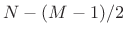 to
to  (negative-time segment). Here we are assuming a 0-based indexing
scheme as used in C or C++. We add 1 to all indices for matlab
indexing to obtain 1:(M-1)/2+1 and N-(M-1)/2+1:N,
respectively. The zero-padding zeros go in between these ranges,
i.e., from
(negative-time segment). Here we are assuming a 0-based indexing
scheme as used in C or C++. We add 1 to all indices for matlab
indexing to obtain 1:(M-1)/2+1 and N-(M-1)/2+1:N,
respectively. The zero-padding zeros go in between these ranges,
i.e., from
 to
to
 .
.
Summary
To summarize, zero-padding is used for
- padding out to the next higher power of 2 so a Cooley-Tukey FFT can be used with any window length,
- improving the quality of spectral displays, and
- oversampling spectral peaks so that some simple final interpolation will be accurate.
Some examples of interpolated spectral display by means of zero-padding may be seen in §3.4.
Next Section:
Spectrum Analysis Windows
Previous Section:
Introduction and Overview












