







Frequency Envelopes
It is convenient in practice to work with instantaneous frequency deviation instead of phase:
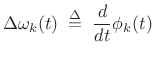 |
(G.9) |
Since the
 th channel of an
  -channel uniform filter-bank has
nominal bandwidth given by
-channel uniform filter-bank has
nominal bandwidth given by  , the frequency deviation usually
does not exceed
, the frequency deviation usually
does not exceed
 .
.
Note that  is a narrow-band signal centered about the channel
frequency
is a narrow-band signal centered about the channel
frequency  . As detailed in Chapter 9, it is typical
to heterodyne the channel signals to ``base band'' by shifting
the input spectrum by
. As detailed in Chapter 9, it is typical
to heterodyne the channel signals to ``base band'' by shifting
the input spectrum by  so that the channel bandwidth is
centered about frequency zero (dc). This may be expressed by
modulating the analytic signal by
so that the channel bandwidth is
centered about frequency zero (dc). This may be expressed by
modulating the analytic signal by
 to get
 |
(G.10) |
The `b' superscript here stands for ``baseband,'' i.e., the channel-filter frequency-response is centered about dc. Working at baseband, we may compute the frequency deviation as simply the time-derivative of the instantaneous phase of the analytic signal:
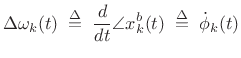 |
(G.11) |
where
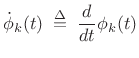 |
(G.12) |
denotes the time derivative of
 . For notational
simplicity, let
. For notational
simplicity, let
 and
and
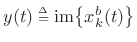 . Then we have
 |
(G.13) |
For discrete time, we replace
 by
by  to obtain [186]

Initially, the sliding FFT was used (hop size
 in the
notation of Chapters 8 and 9). Larger hop sizes can result in phase
ambiguities, i.e., it can be ambiguous exactly how many cycles of a
quasi-sinusoidal component occurred during the hop within a given
channel, especially for high-frequency channels. In many
applications, this is not a serious problem, as it is only necessary
to recreate a psychoacoustically equivalent peak trajectory in the
short-time spectrum. For related discussion,
see [299].
in the
notation of Chapters 8 and 9). Larger hop sizes can result in phase
ambiguities, i.e., it can be ambiguous exactly how many cycles of a
quasi-sinusoidal component occurred during the hop within a given
channel, especially for high-frequency channels. In many
applications, this is not a serious problem, as it is only necessary
to recreate a psychoacoustically equivalent peak trajectory in the
short-time spectrum. For related discussion,
see [299].
Using (G.6) and (G.14) to compute the instantaneous amplitude and frequency for each subband, we obtain data such as shown qualitatively in Fig.G.12. A matlab algorithm for phase unwrapping is given in §F.4.1.
![\begin{psfrags}
% latex2html id marker 42622\psfrag{ak} []{ \LARGE$ a_k(t)$\ }\psfrag{wkt} []{ \LARGE$ \Delta\omega_k(t)=\dot{\phi_k}(t) $\ }\psfrag{wk} []{ \LARGE$ 0 $\ }\psfrag{t} []{ \LARGE$ t$\ }\begin{figure}[htbp]
\includegraphics[width=3.5in]{eps/traj}
\caption{Example amplitude envelope (top)
and frequency envelope (bottom).}
\end{figure}
\end{psfrags}](http://www.dsprelated.com/josimages_new/sasp2/img3033.png)
Next Section:
Envelope Compression
Previous Section:
Further Reading about FM Synthesis












