Kaiser Windows and Transforms
Figure 3.24 plots the Kaiser window and its transform for
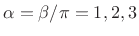 . Note how increasing
  causes the
side-lobes to fall away from the main lobe. The curvature at the main
lobe peak also decreases somewhat.
causes the
side-lobes to fall away from the main lobe. The curvature at the main
lobe peak also decreases somewhat.
 .
.![\includegraphics[width=\twidth]{eps/kaiser123}](http://www.dsprelated.com/josimages_new/sasp2/img499.png)
Figure 3.25 shows a plot of the Kaiser window
for various values of
![$ \beta = [0,2,4,6,8,10]$](http://www.dsprelated.com/josimages_new/sasp2/img500.png) . Note that for
. Note that for  , the
Kaiser window reduces to the rectangular window.
, the
Kaiser window reduces to the rectangular window.
![\includegraphics[width=\twidth]{eps/KaiserTBetas}](http://www.dsprelated.com/josimages_new/sasp2/img501.png)
Figure 3.26 shows a plot of the Kaiser window
transforms for
![$ \beta = [0,2,4,6]$](http://www.dsprelated.com/josimages_new/sasp2/img502.png) . For
(top plot),
we see the dB magnitude of the aliased sinc function. As
. For
(top plot),
we see the dB magnitude of the aliased sinc function. As  increases the main-lobe widens and the side lobes go lower, reaching
almost 50 dB down for
increases the main-lobe widens and the side lobes go lower, reaching
almost 50 dB down for  .
.
![\includegraphics[width=\twidth]{eps/KaiserFBetas}](http://www.dsprelated.com/josimages_new/sasp2/img504.png)
Figure 3.27 shows the effect of increasing window length
for the Kaiser window. The window lengths are
![$ M = [20,30,40,50]$](http://www.dsprelated.com/josimages_new/sasp2/img505.png) from the top to the bottom plot. As with all windows, increasing the
length decreases the main-lobe width, while the side-lobe level
remains essentially unchanged.
from the top to the bottom plot. As with all windows, increasing the
length decreases the main-lobe width, while the side-lobe level
remains essentially unchanged.
![\includegraphics[width=\twidth]{eps/KaiserFLengths}](http://www.dsprelated.com/josimages_new/sasp2/img506.png)
Figure 3.28 shows a plot of the Kaiser window side-lobe level
for various values of
![$ \alpha = [0,0.5,1,1.5,\ldots,4]$](http://www.dsprelated.com/josimages_new/sasp2/img507.png) . For
, the Kaiser window reduces to the rectangular window, and we
expect the side-lobe level to be about 13 dB below the main lobe
(upper-lefthand corner of Fig.3.28). As
. For
, the Kaiser window reduces to the rectangular window, and we
expect the side-lobe level to be about 13 dB below the main lobe
(upper-lefthand corner of Fig.3.28). As
 increases, the dB side-lobe level reduces approximately linearly with
main-lobe width increase (approximately a 25 dB drop in side-lobe
level for each main-lobe width increase by one sinc-main-lobe).
increases, the dB side-lobe level reduces approximately linearly with
main-lobe width increase (approximately a 25 dB drop in side-lobe
level for each main-lobe width increase by one sinc-main-lobe).
![\includegraphics[width=\twidth]{eps/kaiserBeta}](http://www.dsprelated.com/josimages_new/sasp2/img508.png)
Next Section:
Minimum Frequency Separation vs. Window Length
Previous Section:
Kaiser Window Beta Parameter