







Least Squares Sinusoidal Parameter Estimation
There are many ways to define ``optimal'' in signal modeling. Perhaps the most elementary case is least squares estimation. Every estimator tries to measure one or more parameters of some underlying signal model. In the case of sinusoidal parameter estimation, the simplest model consists of a single complex sinusoidal component in additive white noise:
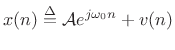
where
 is the complex amplitude of the sinusoid,
and
is the complex amplitude of the sinusoid,
and  is white noise (defined in §C.3). Given
measurements of
is white noise (defined in §C.3). Given
measurements of  ,
,
 , we wish to estimate the
parameters
, we wish to estimate the
parameters
 of this sinusoid. In the method of
least squares, we minimize the sum of squared errors between the data
and our model. That is, we minimize
of this sinusoid. In the method of
least squares, we minimize the sum of squared errors between the data
and our model. That is, we minimize
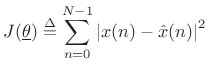
with respect to the parameter vector
![$\displaystyle \underline{\theta}\isdef \left[\begin{array}{c} A \\ [2pt] \phi \\ [2pt] \omega_0 \end{array}\right],$](http://www.dsprelated.com/josimages_new/sasp2/img1033.png) |
(6.34) |
where
 denotes our signal model:
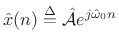 |
(6.35) |
Note that the error signal
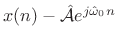 is
linear in
is
linear in
 but
nonlinear in the parameter
but
nonlinear in the parameter
 . More significantly,
 is non-convex with respect to variations in
. Non-convexity can make an optimization based on gradient
descent very difficult, while convex optimization problems can
generally be solved quite efficiently [22,86].
is non-convex with respect to variations in
. Non-convexity can make an optimization based on gradient
descent very difficult, while convex optimization problems can
generally be solved quite efficiently [22,86].
Sinusoidal Amplitude Estimation
If the sinusoidal frequency  and phase
  happen to be
known, we obtain a simple linear least squares problem for the
amplitude
happen to be
known, we obtain a simple linear least squares problem for the
amplitude  . That is, the error signal
 |
(6.36) |
becomes linear in the unknown parameter
 . As a result, the
sum of squared errors
. As a result, the
sum of squared errors
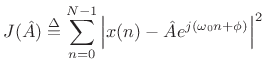
becomes a simple quadratic (parabola) over the real line.6.11 Quadratic forms in any number of dimensions are easy to minimize. For example, the ``bottom of the bowl'' can be reached in one step of Newton's method. From another point of view, the optimal parameter
can be obtained as
the coefficient of orthogonal projection of the data
onto the space spanned by all values of
in the linear model
 .
.
Yet a third way to minimize (5.37) is the method taught in
elementary calculus: differentiate
 with respect to
, equate
it to zero, and solve for
. In preparation for this, it is helpful to
write (5.37) as
with respect to
, equate
it to zero, and solve for
. In preparation for this, it is helpful to
write (5.37) as
![\begin{eqnarray*}
J({\hat A}) &\isdef & \sum_{n=0}^{N-1}
\left[x(n)-{\hat A}e^{j(\omega_0 n+\phi)}\right]
\left[\overline{x(n)}-\overline{{\hat A}} e^{-j(\omega_0 n+\phi)}\right]\\
&=&
\sum_{n=0}^{N-1}
\left[
\left\vert x(n)\right\vert^2
-
x(n)\overline{{\hat A}} e^{-j(\omega_0 n+\phi)}
-
\overline{x(n)}{\hat A}e^{j(\omega_0 n+\phi)}
+
{\hat A}^2
\right]
\\
&=& \left\Vert\,x\,\right\Vert _2^2 - 2\mbox{re}\left\{\sum_{n=0}^{N-1} x(n)\overline{{\hat A}}
e^{-j(\omega_0 n+\phi)}\right\}
+ N {\hat A}^2.
\end{eqnarray*}](http://www.dsprelated.com/josimages_new/sasp2/img1045.png)
Differentiating with respect to
and equating to zero yields
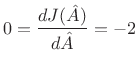 re re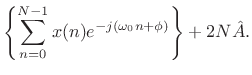 |
(6.38) |
Solving this for
gives the optimal least-squares amplitude estimate
 re
re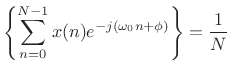 re
re![$\displaystyle \left\{\hbox{\sc DTFT}_{\omega_0 }\left[e^{-j\phi} x\right]\right\}. \protect$](http://www.dsprelated.com/josimages_new/sasp2/img1050.png)
That is, the optimal least-squares amplitude estimate may be found by the following steps:
- Multiply the data
by
 to zero the known phase
.
to zero the known phase
.
- Take the DFT of the
 samples of
  , suitably zero padded to approximate the DTFT, and evaluate it at the known frequency
.
, suitably zero padded to approximate the DTFT, and evaluate it at the known frequency
.
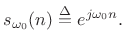
- Discard any imaginary part since it can only contain noise, by (5.39).
- Divide by
to obtain a properly normalized coefficient of projection
[264] onto the sinusoid
(6.40)
Sinusoidal Amplitude and Phase Estimation
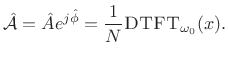
The form of the optimal estimator (5.39) immediately suggests the following generalization for the case of unknown amplitude and phase:

That is,
is given by the complex coefficient of
projection [264] of
onto the complex sinusoid
 at the known frequency
. This can be shown by generalizing the
previous derivation, but here we will derive it using the more
enlightened orthogonality principle [114].
at the known frequency
. This can be shown by generalizing the
previous derivation, but here we will derive it using the more
enlightened orthogonality principle [114].
The orthogonality principle for linear least squares estimation states
that the projection error must be orthogonal to the model.
That is, if  is our optimal signal model (viewed now as an
-vector in
is our optimal signal model (viewed now as an
-vector in  ), then we must have [264]

Thus, the complex coefficient of projection of
onto
 is given by
 |
(6.42) |
The optimality of
in the least squares sense follows from the
least-squares optimality of orthogonal projection
[114,121,252]. From a geometrical point of view,
referring to Fig.5.16, we say that the minimum distance from a
vector
 to some lower-dimensional subspace
  , where
 (here
(here  for one complex sinusoid) may be found by ``dropping
a perpendicular'' from
to the subspace. The point
at the
foot of the perpendicular is the point within the subspace closest to
in Euclidean distance.
for one complex sinusoid) may be found by ``dropping
a perpendicular'' from
to the subspace. The point
at the
foot of the perpendicular is the point within the subspace closest to
in Euclidean distance.
 |
 ,
,  ).
The orthogonal projection
).
The orthogonal projection  .
.
Sinusoidal Frequency Estimation
The form of the least-squares estimator (5.41) in the known-frequency case immediately suggests the following frequency estimator for the unknown-frequency case:

That is, the sinusoidal frequency estimate is defined as that frequency which maximizes the DTFT magnitude. Given this frequency, the least-squares sinusoidal amplitude and phase estimates are given by (5.41) evaluated at that frequency.
It can be shown [121] that (5.43) is in fact the optimal least-squares estimator for a single sinusoid in white noise. It is also the maximum likelihood estimator for a single sinusoid in Gaussian white noise, as discussed in the next section.
In summary,

In practice, of course, the DTFT is implemented as an interpolated FFT, as described in the previous sections (e.g., QIFFT method).
Next Section:
Maximum Likelihood Sinusoid Estimation
Previous Section:
Bias of Parabolic Peak Interpolation












