Linear Prediction Spectral Envelope
Linear Prediction (LP) implicitly computes a spectral envelope that is well adapted for audio work, provided the order of the predictor is appropriately chosen. Due to the error minimized by LP, spectral peaks are emphasized in the envelope, as they are in the auditory system. (The peak-emphasis of LP is quantified in (10.10) below.)
The term ``linear prediction'' refers to the process of predicting a
signal sample  based on
  past samples:

We call
the order of the linear predictor, and
 the prediction coefficients.
The prediction error (or ``innovations
sequence'' [114]) is denoted
the prediction coefficients.
The prediction error (or ``innovations
sequence'' [114]) is denoted  in (10.4),
and it represents all new information entering the signal
in (10.4),
and it represents all new information entering the signal  at time
 . Because the information is new,
is ``unpredictable.''
The predictable component of
contains no new information.
. Because the information is new,
is ``unpredictable.''
The predictable component of
contains no new information.
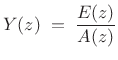
Taking the z transform of (10.4) yields
 |
(11.5) |
where
 .
In signal modeling by linear prediction, we are given the signal
but not the prediction coefficients
.
In signal modeling by linear prediction, we are given the signal
but not the prediction coefficients  . We must
therefore estimate them. Let
. We must
therefore estimate them. Let
 denote the polynomial with estimated prediction
coefficients
denote the polynomial with estimated prediction
coefficients
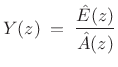
 . Then we have
 |
(11.6) |
where
 denotes the estimated prediction-error z transform. By
minimizing
denotes the estimated prediction-error z transform. By
minimizing
 , we define a minimum-least-squares estimate
 . In other words, the linear prediction coefficients
are
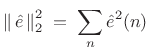
defined as those which minimize the sum of squared prediction errors
. In other words, the linear prediction coefficients
are
defined as those which minimize the sum of squared prediction errors

 |
(11.7) |
over some range of
, typically an interval over which the signal
is stationary (defined in Chapter 6). It turns out
that this minimization results in maximally flattening the
prediction-error spectrum  [11,157,162].
That is, the optimal
[11,157,162].
That is, the optimal
 is a whitening filter (also
called an inverse filter). This makes sense in terms
of Chapter 6 when one considers that a flat power spectral
density corresponds to white noise in the time domain, and only white
noise is completely unpredictable from one sample to the next. A
non-flat spectrum corresponds to a nonzero correlation between two
signal samples separated by some nonzero time interval.
is a whitening filter (also
called an inverse filter). This makes sense in terms
of Chapter 6 when one considers that a flat power spectral
density corresponds to white noise in the time domain, and only white
noise is completely unpredictable from one sample to the next. A
non-flat spectrum corresponds to a nonzero correlation between two
signal samples separated by some nonzero time interval.
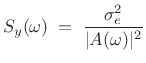
If the prediction-error is successfully whitened, then the signal model can be expressed in the frequency domain as
 |
(11.8) |
where
 denotes the power spectral density of
(defined
in Chapter 6), and
denotes the power spectral density of
(defined
in Chapter 6), and
 denotes the variance of
the (white-noise) prediction error
. Thus, the spectral
magnitude envelope may be defined as
denotes the variance of
the (white-noise) prediction error
. Thus, the spectral
magnitude envelope may be defined as
EnvelopeLPC |
(11.9) |
Linear Prediction is Peak Sensitive
By Rayleigh's energy theorem,
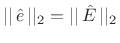 (as
shown in §2.3.8). Therefore,
(as
shown in §2.3.8). Therefore,


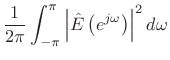

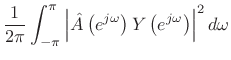
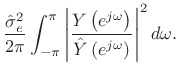
From this ``ratio error'' expression in the frequency domain, we can see that contributions to the error are smallest when
 . Therefore, LP tends to overestimate
peaks. LP cannot make
. Therefore, LP tends to overestimate
peaks. LP cannot make
 arbitrarily large because
  is
constrained to be monic and minimum-phase. It can be shown that the
log-magnitude frequency response of every minimum-phase monic
polynomial
is zero-mean [162]. Therefore, for each
peak overestimation, there must be an equal-area ``valley
underestimation'' (in a log-magnitude plot over the unit circle).
is
constrained to be monic and minimum-phase. It can be shown that the
log-magnitude frequency response of every minimum-phase monic
polynomial
is zero-mean [162]. Therefore, for each
peak overestimation, there must be an equal-area ``valley
underestimation'' (in a log-magnitude plot over the unit circle).
Linear Prediction Methods
The two classic methods for linear prediction are called the autocorrelation method and the covariance method [162,157]. Both methods solve the linear normal equations (defined below) using different autocorrelation estimates.
In the autocorrelation method of linear prediction, the covariance
matrix is constructed from the usual Bartlett-window-biased sample
autocorrelation function (see Chapter 6), and it has the
desirable property that
is always minimum phase (i.e.,
 is guaranteed to be stable). However, the autocorrelation
method tends to overestimate formant bandwidths; in other words, the
filter model is typically overdamped. This can be attributed to
implicitly ``predicting zero'' outside of the signal frame, resulting
in the Bartlett-window bias in the sample autocorrelation.
is guaranteed to be stable). However, the autocorrelation
method tends to overestimate formant bandwidths; in other words, the
filter model is typically overdamped. This can be attributed to
implicitly ``predicting zero'' outside of the signal frame, resulting
in the Bartlett-window bias in the sample autocorrelation.
The covariance method of LP is based on an unbiased
autocorrelation estimate (see Eq. (6.4)). As a result, it
gives more accurate bandwidths, but it does not guarantee stability.
(6.4)). As a result, it
gives more accurate bandwidths, but it does not guarantee stability.
So-called covariance lattice methods and Burg's method were developed to maintain guaranteed stability while giving accuracy comparable to the covariance method of LP [157].
Computation of Linear Prediction Coefficients
In the autocorrelation method of linear prediction, the linear
prediction coefficients
are computed from the
Bartlett-window-biased autocorrelation function
(Chapter 6):

where
 denotes the
  th data frame from the signal
.
To obtain the
th-order linear predictor coefficients
th data frame from the signal
.
To obtain the
th-order linear predictor coefficients
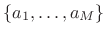 , we solve the following
  system of
linear normal equations (also called Yule-Walker
or Wiener-Hopf equations):
system of
linear normal equations (also called Yule-Walker
or Wiener-Hopf equations):

In matlab syntax, the solution is given by ``
 '', where
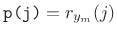 , and
, and
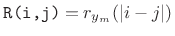 . Since
the covariance matrix
. Since
the covariance matrix  is symmetric and Toeplitz by
construction,11.4 an
is symmetric and Toeplitz by
construction,11.4 an  solution exists using
the Durbin
recursion.11.5
solution exists using
the Durbin
recursion.11.5
If the rank of the
autocorrelation matrix
![$ R[i,j]=r_{y_n}(\vert i-j\vert)$](http://www.dsprelated.com/josimages_new/sasp2/img1769.png) is
, then the solution to (10.12)
is unique, and
this solution is always minimum phase [162] (i.e., all roots of
are inside the unit circle in the
is
, then the solution to (10.12)
is unique, and
this solution is always minimum phase [162] (i.e., all roots of
are inside the unit circle in the  plane [263], so
that
plane [263], so
that  is always a stable all-pole filter). In
practice, the rank of
is
(with probability 1) whenever
includes a noise component. In the noiseless case, if
is a sum
of sinusoids, each (real) sinusoid at distinct frequency
is always a stable all-pole filter). In
practice, the rank of
is
(with probability 1) whenever
includes a noise component. In the noiseless case, if
is a sum
of sinusoids, each (real) sinusoid at distinct frequency
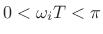 adds 2 to the rank. A dc component, or a component at half the
sampling rate, adds 1 to the rank of
.
adds 2 to the rank. A dc component, or a component at half the
sampling rate, adds 1 to the rank of
.
The choice of time window for forming a short-time sample
autocorrelation and its weighting also affect the rank of
. Equation (10.11) applied to a finite-duration frame yields what is
called the autocorrelation method of linear
prediction [162]. Dividing out the Bartlett-window bias in such a
sample autocorrelation yields a result closer to the covariance method
of LP. A matlab example is given in §10.3.3 below.
The classic covariance method computes an unbiased sample covariance
matrix by limiting the summation in (10.11) to a range over which
 stays within the frame--a so-called ``unwindowed'' method.
The autocorrelation method sums over the whole frame and replaces
by zero when
stays within the frame--a so-called ``unwindowed'' method.
The autocorrelation method sums over the whole frame and replaces
by zero when  points outside the frame--a so-called
``windowed'' method (windowed by the rectangular window).
points outside the frame--a so-called
``windowed'' method (windowed by the rectangular window).
Linear Prediction Order Selection
For computing spectral envelopes via linear prediction, the order
of the predictor should be chosen large enough that the envelope can
follow the contour of the spectrum, but not so large that it follows
the spectral ``fine structure'' on a scale not considered to belong in
the envelope. In particular, for voice,
should be twice the
number of spectral formants, and perhaps a little larger to
allow more detailed modeling of spectral shape away from the formants.
For a sum of quasi sinusoids, the order
should be significantly
less than twice the number of sinusoids to inhibit modeling the
sinusoids as spectral-envelope peaks. For filtered-white-noise,
should be close to the order of the filter applied to the white noise,
and so on.
Summary of LP Spectral Envelopes
In summary, the spectral envelope of the
th spectral frame,
computed by linear prediction, is given by
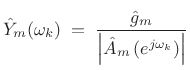 |
(11.13) |
where
 is computed from the solution of the Toeplitz normal
equations, and
is computed from the solution of the Toeplitz normal
equations, and
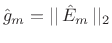 is the estimated rms level
of the prediction error in the
th frame.
is the estimated rms level
of the prediction error in the
th frame.
 |
(11.14) |
can be driven by unit-variance white noise to produce a filtered-white-noise signal having spectral envelope
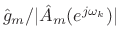 . We may regard
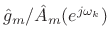 (no absolute value) as the frequency
response of the filter in a source-filter decomposition of the
signal
(no absolute value) as the frequency
response of the filter in a source-filter decomposition of the
signal  , where the source is white noise.
It bears repeating that
 is zero mean when
is monic and minimum phase (all zeros inside the unit circle).
This means, for example, that
is zero mean when
is monic and minimum phase (all zeros inside the unit circle).
This means, for example, that
 can be simply estimated as
the mean of the log spectral magnitude
can be simply estimated as
the mean of the log spectral magnitude
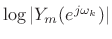 .
.
For best results, the frequency axis ``seen'' by linear prediction should be warped to an auditory frequency scale, as discussed in Appendix E [123]. This has the effect of increasing the accuracy of low-frequency peaks in the extracted spectral envelope, in accordance with the nonuniform frequency resolution of the inner ear.
Next Section:
Spectral Envelope Examples
Previous Section:
Cepstral Windowing