Matlab/Octave fftshift utility
Matlab and Octave have a simple utility called fftshift that performs this bin rotation. Consider the following example:
octave:4>
fftshift([1 2 3 4])
ans =
  3  4  1  2
octave:5>
If the vector [1 2 3 4] is the output of a length 4 FFT, then the first element (1) is the dc term, and the third element (3) is the point at half the sampling rate (
 ), which can be taken to be
either plus or minus
since they are the same point on the
unit circle in the
), which can be taken to be
either plus or minus
since they are the same point on the
unit circle in the  plane. Elements 2 and 4 are plus and minus
 , respectively. After fftshift, element (3) is first,
which indicates that both Matlab and Octave regard the spectral sample
at half the sampling rate as a negative frequency. The next element
is 4, corresponding to frequency
, respectively. After fftshift, element (3) is first,
which indicates that both Matlab and Octave regard the spectral sample
at half the sampling rate as a negative frequency. The next element
is 4, corresponding to frequency  , followed by dc and
.
, followed by dc and
.
Another reasonable result would be fftshift([1 2 3 4]) == [4 1
2 3], which defines half the sampling rate as a positive frequency.
However, giving
to the negative frequencies balances giving dc
to the positive frequencies, and the number of samples on both sides
is then the same. For an odd-length DFT, there is no point at
 , so the result
octave:4>
fftshift([1 2 3])
ans =
  3  1  2
octave:5>
is the only reasonable answer, corresponding to frequencies
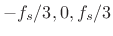 , respectively.
Next Section:
Index Ranges for Zero-Phase Zero-Padding
Previous Section:
Zero-Padding for Interpolating Spectral Peaks