Maximum Likelihood Sinusoid Estimation
The maximum likelihood estimator (MLE) is widely used in practical signal modeling [121]. A full treatment of maximum likelihood estimators (and statistical estimators in general) lies beyond the scope of this book. However, we will show that the MLE is equivalent to the least squares estimator for a wide class of problems, including well resolved sinusoids in white noise.
Consider again the signal model of (5.32) consisting of a complex sinusoid in additive white (complex) noise:
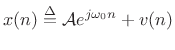
Again,
 is the complex amplitude of the sinusoid, and
  is
white noise. In addition to assuming
is
white noise. In addition to assuming  is white, we add the
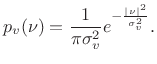
assumption that it is Gaussian distributed6.12 with zero mean; that is, we assume that its
probability density function (see Appendix C) is given
by6.13
is white, we add the
assumption that it is Gaussian distributed6.12 with zero mean; that is, we assume that its
probability density function (see Appendix C) is given
by6.13
 |
(6.46) |
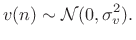
We express the zero-mean Gaussian assumption by writing
 |
(6.47) |
The parameter
 is called the variance of the random
process
, and
is called the variance of the random
process
, and  is called the standard
deviation.
is called the standard
deviation.
It turns out that when Gaussian random variables
are
uncorrelated (i.e., when
is white noise), they are also
independent. This means that the probability of observing
particular values of
and  is given by the product of
their respective probabilities [121]. We will now use this
fact to compute an explicit probability for observing any data
sequence
is given by the product of
their respective probabilities [121]. We will now use this
fact to compute an explicit probability for observing any data
sequence  in (5.44).
Since the sinusoidal part of our signal model,
 , is deterministic; i.e., it does not including any random
components; it may be treated as the time-varying mean of a
Gaussian random process
. That is, our signal model
(5.44) can be rewritten as
, is deterministic; i.e., it does not including any random
components; it may be treated as the time-varying mean of a
Gaussian random process
. That is, our signal model
(5.44) can be rewritten as
 |
(6.48) |
and the probability density function for the whole set of observations
,
 is given by
![$\displaystyle p(x) = p[x(0)] p[x(1)]\cdots p[x(N-1)] = \left(\frac{1}{\pi \sigma_v^2}\right)^N e^{-\frac{1}{\sigma_v^2}\sum_{n=0}^{N-1} \left\vert x(n) - {\cal A}e^{j\omega_0 n}\right\vert^2}$](http://www.dsprelated.com/josimages_new/sasp2/img1079.png) |
(6.49) |
Thus, given the noise variance
and the three sinusoidal
parameters
 (remember that
), we can
compute the relative probability of any observed data samples
.
(remember that
), we can
compute the relative probability of any observed data samples
.
Next Section:
Likelihood Function
Previous Section:
Least Squares Sinusoidal Parameter Estimation