The Nyquist Property on the Unit Circle
As a degenerate case, note that  is COLA for any window, while no
window transform is
is COLA for any window, while no
window transform is
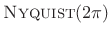 except the zero window. (since it
would have to be zero at dc, and we do not consider such windows).
Did the theory break down for
?
except the zero window. (since it
would have to be zero at dc, and we do not consider such windows).
Did the theory break down for
?
Intuitively, the
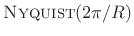 condition on the window transform
 ensures that all nonzero multiples of the
time-domain-frame-rate
ensures that all nonzero multiples of the
time-domain-frame-rate  will be zeroed out over the interval
 along the frequency axis. When the frame-rate equals the
sampling rate (
), there are no frame-rate multiples in the
range
. (The range
along the frequency axis. When the frame-rate equals the
sampling rate (
), there are no frame-rate multiples in the
range
. (The range  gives the same result.)
When
gives the same result.)
When  , there is exactly one frame-rate multiple at
  . When
 , there are two at
 . When
  , they are at
and
, they are at
and  , and so on.
We can cleanly handle the special case of
by defining all
functions over the unit circle as being
when there are no
frame-rate multiples in the range
. Thus, a discrete-time
spectrum
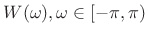 is said to be
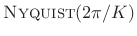 if
if
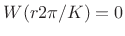 , for all
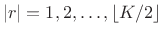 , where
 (the ``floor function'') denotes the greatest integer less
than or equal to
(the ``floor function'') denotes the greatest integer less
than or equal to  .
.
Next Section:
Filter Bank Reconstruction
Previous Section:
Specific Windows