Periodic-Hamming OLA from Poisson Summation Formula
Matlab code:
ff = 1/R; % frame rate (fs=1)
N = 6*M;  % no. samples to look at OLA
sp = ones(N,1)*sum(w)/R; % dc term (COLA term)
ubound = sp(1);  % try easy-to-compute upper bound
lbound = ubound; % and lower bound
n = (0:N-1)';
for (k=1:R-1) % traverse frame-rate harmonics
  f=ff*k;
  csin = exp(j*2*pi*f*n); % frame-rate harmonic
  % find exact window transform at frequency f
  Wf = w' * conj(csin(1:M));
  hum = Wf*csin;   % contribution to OLA "hum"
  sp = sp + hum/R; % "Poisson summation" into OLA
  % Update lower and upper bounds:
  Wfb = abs(Wf);
  ubound = ubound + Wfb/R; % build upper bound
  lbound = lbound - Wfb/R; % build lower bound
end
In this example, the overlap-add is theoretically a perfect constant
(equal to  ) because the frame rate and all its harmonics
coincide with nulls in the window transform (see
Fig.9.24). A plot of the steady-state
overlap-add and that computed using the Poisson Summation Formula (not
shown) is constant to within numerical precision. The
difference between the actual overlap-add and that computed
using the PSF is shown in Fig.9.23. We verify that the
difference is on the order of
) because the frame rate and all its harmonics
coincide with nulls in the window transform (see
Fig.9.24). A plot of the steady-state
overlap-add and that computed using the Poisson Summation Formula (not
shown) is constant to within numerical precision. The
difference between the actual overlap-add and that computed
using the PSF is shown in Fig.9.23. We verify that the
difference is on the order of  , which is close enough to
zero in double-precision (64-bit) floating-point computations. We
thus verify that the overlap-add of a length
, which is close enough to
zero in double-precision (64-bit) floating-point computations. We
thus verify that the overlap-add of a length  Hamming window using
a hop size of
Hamming window using
a hop size of
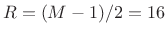 samples is constant to within machine
precision.
samples is constant to within machine
precision.
![\includegraphics[width=\textwidth ]{eps/olassmmpHammingC}](http://www.dsprelated.com/josimages_new/sasp2/img1692.png)
Figure 9.24 shows the zero-padded DFT of the
modified Hamming window we're using (
 ) with the
frame-rate harmonics marked. In this example (
) with the
frame-rate harmonics marked. In this example ( ), the upper
half of the main lobe aliases into the lower half of the main
lobe. (In fact, all energy above the folding frequency
), the upper
half of the main lobe aliases into the lower half of the main
lobe. (In fact, all energy above the folding frequency  aliases into the lower half of the main lobe.) While this window and
hop size still give perfect reconstruction under the STFT, spectral
modifications will disturb the aliasing cancellation during
reconstruction. This ``undersampled'' configuration is suitable as a
basis for compression applications.
aliases into the lower half of the main lobe.) While this window and
hop size still give perfect reconstruction under the STFT, spectral
modifications will disturb the aliasing cancellation during
reconstruction. This ``undersampled'' configuration is suitable as a
basis for compression applications.
![\includegraphics[width=\textwidth ]{eps/windowTransformHammingC}](http://www.dsprelated.com/josimages_new/sasp2/img1695.png)
Note that if we were to cut  in half to
  , then the folding
frequency in Fig.9.24 would coincide with the
first null in the window transform. Since the frame rate and all its
harmonics continue to land on nulls in the window transform,
overlap-add is still exact. At this reduced hop size, however, the
STFT becomes much more robust to spectral modifications, because all
aliasing in the effective downsampled filter bank is now weighted by
the side lobes of the window transform, with no aliasing
components coming from within the main lobe. This is the central
result of [9].
, then the folding
frequency in Fig.9.24 would coincide with the
first null in the window transform. Since the frame rate and all its
harmonics continue to land on nulls in the window transform,
overlap-add is still exact. At this reduced hop size, however, the
STFT becomes much more robust to spectral modifications, because all
aliasing in the effective downsampled filter bank is now weighted by
the side lobes of the window transform, with no aliasing
components coming from within the main lobe. This is the central
result of [9].
Next Section:
Kaiser Overlap-Add Example
Previous Section:
Hamming Overlap-Add Example