







Poisson Summation Formula
As shown in §B.14 above, the Fourier transform of an impulse train is an impulse train with inversely proportional spacing:
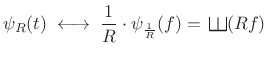 |
(B.56) |
where
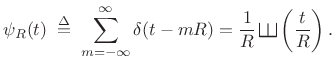 |
(B.57) |
Using this Fourier theorem, we can derive the continuous-time PSF using the convolution theorem for Fourier transforms:B.1
 |
(B.58) |
Using linearity and the shift theorem for inverse Fourier transforms, the above relation yields
![\begin{eqnarray*}
\sum_m w(t-mR)
&=& \frac{1}{R} \hbox{\sc IFT}_t
\left[W(f)\sum_k\delta\left(f-k\frac{1}{R}\right) \right]
\quad\left(\mbox{define $f_k\isdef \frac{k}{R}$}\right)
\\ [5pt]
&=& \frac{1}{R} \hbox{\sc IFT}_t
\left[\sum_k W(f_k)\cdot\delta\left(f-f_k\right) \right]\\ [5pt]
&=& \frac{1}{R}
\sum_k W(f_k)\cdot\hbox{\sc IFT}_t \left[\delta\left(f-f_k\right) \right]\\ [5pt]
&=& \frac{1}{R} \sum_k W(f_k)e^{j 2\pi f_k t}.
\end{eqnarray*}](http://www.dsprelated.com/josimages_new/sasp2/img2530.png)
We have therefore shown

Compare this result to Eq.
 (8.30). The left-hand side of (B.60)
can be interpreted
(8.30). The left-hand side of (B.60)
can be interpreted
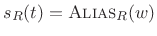 , i.e., the time-alias of
  on
a block of length
on
a block of length  . The function
  is periodic with period
seconds. The right-hand side of (B.60) can be interpreted as
the inverse Fourier series of
is periodic with period
seconds. The right-hand side of (B.60) can be interpreted as
the inverse Fourier series of  sampled at intervals of
  Hz. This sampling of
  in the frequency domain corresponds to the aliasing of
  in the
time domain.
in the
time domain.
Next Section:
Sampling Theory
Previous Section:
Impulse Trains












