Polyphase Analysis of Portnoff STFT
Consider the  th filter-bank channel filter
 |
(12.96) |
The impulse-response
 can be any length
  sequence. Denote
the
sequence. Denote
the  -channel polyphase components of
  by
by  ,
,
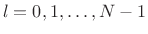 . Then by the polyphase decomposition
(§11.2.2), we have
. Then by the polyphase decomposition
(§11.2.2), we have
![\begin{eqnarray*}
H_{0}(z) & = & \sum_{l=0}^{N-1} z^{-l}E_l(z^{N}) \\ [5pt]
H_{k}(z) & = & \sum_{l=0}^{N-1} (zW_N^k)^{-l} E_l[(z W_N^k)^{N}] \\ [5pt]
& = & \sum_{l=0}^{N-1} z^{-l} E_l(z^{N}) W_N^{-kl}.
\end{eqnarray*}](http://www.dsprelated.com/josimages_new/sasp2/img2238.png)
Consequently,
![\begin{eqnarray*}
H_{k}(z)X(z) & = & \sum_{l=0}^{N-1} z^{-l} E_l(z^{N})X(z) W_N^{-kl} \\
\left[\begin{array}{c}
H_{0}(z) \\
\ldots \\
H_{N-1}(z) \end{array} \right]
& = & \left[\begin{array}{ccc}
& & \\
& W_N^{-kl} & \\
& & \end{array} \right]
\left[\begin{array}{c}
E_0(z^N) z^{-0} X(z) \\
\ldots \\
E_{N-1}(z^N) z^{-(N-1)} X(z) \end{array}
\right].
\end{eqnarray*}](http://www.dsprelated.com/josimages_new/sasp2/img2239.png)
If  is a good
th-band lowpass, the subband signals
is a good
th-band lowpass, the subband signals
 are bandlimited to a region of width
  . As a result,
there is negligible aliasing when we downsample each of the subbands
by
. Commuting the downsamplers to get an efficient implementation
gives Fig.11.29.
. As a result,
there is negligible aliasing when we downsample each of the subbands
by
. Commuting the downsamplers to get an efficient implementation
gives Fig.11.29.
![\begin{psfrags}
% latex2html id marker 30545\psfrag{X(z)}{{\large $X(z)$}}\psfrag{E0(z^3)}{{\large $E_0(z^3)$}}\psfrag{E1(z^3)}{{\large $E_1(z^3)$}}\psfrag{E2(z^3)}{{\large $E_2(z^3)$}}\psfrag{E0(z)}{{\large $E_0(z)$}}\psfrag{E1(z)}{{\large $E_1(z)$}}\psfrag{E2(z)}{{\large $E_2(z)$}}\psfrag{X0(z)}{{\large $X_0(z)$}}\psfrag{X1(z)}{{\large $X_1(z)$}}\psfrag{X2(z)}{{\large $X_2(z)$}}\begin{figure}[htbp]
\includegraphics[width=\twidth]{eps/polystft}
\caption{Polyphase implementation of
Portnoff STFT filter bank for $N=3$.}
\end{figure}
\end{psfrags}](http://www.dsprelated.com/josimages_new/sasp2/img2241.png)
First note that if
 for all
, the system of
Fig.11.29 reduces to a rectangularly windowed STFT in which the
window length
for all
, the system of
Fig.11.29 reduces to a rectangularly windowed STFT in which the
window length  equals the DFT length
  . The downsamplers
``hold off'' the DFT until the length 3 delay line fills with new
input samples, then it ``fires'' to produce a spectral frame. A new
spectral frame is produced after every third sample of input data is
received.
. The downsamplers
``hold off'' the DFT until the length 3 delay line fills with new
input samples, then it ``fires'' to produce a spectral frame. A new
spectral frame is produced after every third sample of input data is
received.
In the more general case in which  are nontrivial filters,
such as
are nontrivial filters,
such as
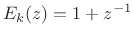 , for example, they can be seen to compute the
equivalent of a time aliased windowed input frame, such as
, for example, they can be seen to compute the
equivalent of a time aliased windowed input frame, such as
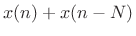 . This follows because the filters operate on the
downsampled input stream, so that the filter coefficients operate on
signal samples separated by
samples. The linear combination of
these samples by the filter implements the time-aliased windowed data
frame in a Portnoff-windowed overlap-add STFT. Taken together, the
polyphase filters
compute the appropriately time-aliased data
frame windowed by
. This follows because the filters operate on the
downsampled input stream, so that the filter coefficients operate on
signal samples separated by
samples. The linear combination of
these samples by the filter implements the time-aliased windowed data
frame in a Portnoff-windowed overlap-add STFT. Taken together, the
polyphase filters
compute the appropriately time-aliased data
frame windowed by
 .
.
In the overlap-add interpretation of Fig.11.29, the window is
hopped by
samples. While this was the entire window length in
the rectangular window case (
), it is only a portion of the
effective frame length
when the analysis filters have order 1 or
greater.
Next Section:
Pseudo-QMF Cosine Modulation Filter Bank
Previous Section:
Examples