Portnoff Windows
In 1976 [212], Portnoff observed that any window  of the form
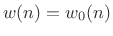 sinc sinc |
(10.23) |
being
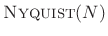 by construction, will obey the weak
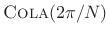 constraint, where
  is the number of spectral samples. In this
result,
is the number of spectral samples. In this
result,  is any window function whatsoever, and the sinc
function is defined as usual by
is any window function whatsoever, and the sinc
function is defined as usual by
sinc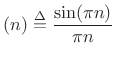 |
(10.24) |
(the unit-amplitude sinc function with zeros at all nonzero integers).
Portnoff suggested that, in practical usage, windowed data segments
longer than the FFT size should be time-aliased about length
prior to performing an FFT. This result is readily derived from the
definition of the time-normalized STFT introduced in Eq. (8.21):
![\begin{eqnarray*}
{\tilde X}_m(\omega_k)
&\isdef & \hbox{\sc Sample}_{\Omega_N,k}\left(\hbox{\sc DTFT}\left({\tilde x}_m\right)\right) \\
&\isdef & \hbox{\sc Sample}_{\Omega_N,k}\left(\hbox{\sc DTFT}\left(\hbox{\sc Shift}_{-m}(x)\cdot w\right)\right) \\
&=& \sum_{n=-\infty}^\infty x(n+m)w(n)e^{-j\omega_k n}\quad\hbox{(now let $n\isdef lN+i$)}\\
&=& \sum_{l=-\infty}^\infty \sum_{i=0}^{N-1}x(lN+i+m)w(lN+i)
\underbrace{e^{-j\omega_k (lN+i)}}_{e^{-j\omega_k i}}\\
&=& \sum_{i=0}^{N-1}\left[\sum_{l=-\infty}^\infty x(lN+i+m)w(lN+i)\right]
e^{-j\omega_k i}\\
&=& \sum_{i=0}^{N-1}\hbox{\sc Alias}_{N,i}[\hbox{\sc Shift}_{-m}(x)\cdot w] e^{-j\omega_k i}\\
&\isdef & \hbox{\sc DFT}_{N,k}\{\hbox{\sc Alias}_N[\hbox{\sc Shift}_{-m}(x)\cdot w]\},
\end{eqnarray*}](http://www.dsprelated.com/josimages_new/sasp2/img1655.png)
where
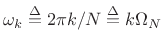 as usual.
Choosing  allows multiple side lobes of the sinc function to
alias in on the main lobe. This gives channel filters in the
frequency domain which are sharper bandpass filters while remaining COLA.
I.e., there is less channel cross-talk in the frequency domain.
However, the time-aliasing
corresponds to undersampling in the frequency domain, implying less
robustness to spectral modifications, since such modifications can
disturb the time-domain aliasing cancellation. Since the hop size
needs to be less than
, the overall filter bank based on a Portnoff
window remains oversampled in the time domain.
allows multiple side lobes of the sinc function to
alias in on the main lobe. This gives channel filters in the
frequency domain which are sharper bandpass filters while remaining COLA.
I.e., there is less channel cross-talk in the frequency domain.
However, the time-aliasing
corresponds to undersampling in the frequency domain, implying less
robustness to spectral modifications, since such modifications can
disturb the time-domain aliasing cancellation. Since the hop size
needs to be less than
, the overall filter bank based on a Portnoff
window remains oversampled in the time domain.
Next Section:
Downsampled STFT Filter Banks
Previous Section:
Duality of COLA and Nyquist Conditions