Sign in

username:

password:


Not a member?

Search Online Books


Search tips

Free Online Books

Chapters

Chapter Contents:

Search Spectral Audio Signal Processing


Book Index | Global Index


Would you like to be notified by email when Julius Orion Smith III publishes a new entry into his blog?


Power Theorem for the DTFT

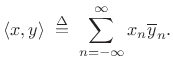
The inner product of two signals is defined in the time domain by

$\displaystyle \left<x,y\right> \isdef \sum_{n=-\infty}^{\infty} x_n\overline{y}_n.
$

The inner product of two spectra may be defined as
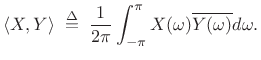
$\displaystyle \left<X,Y\right> \isdef \frac{1}{2\pi}\int_{-\pi}^\pi X(\omega)\overline{Y(\omega)} d\omega.
$

Note that the frequency-domain inner product includes a normalization factor while the time-domain definition does not.

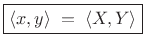
Using inner-product notation, the power theorem (or Parseval's theorem [186]) for DTFTs can be stated as follows:

$\displaystyle \zbox {\left<x,y\right> = \left<X,Y\right>}
$

That is, the inner product of two signals in the time domain equals the inner product of their respective spectra (a complex scalar in general).

When we consider the inner product of a signal with itself, we have the special case known as the energy theorem (or Rayleigh's energy theorem):

$\displaystyle \Vert x \Vert^2 = \left<x,x\right> = \left<X,X\right> = \Vert X \Vert^2
$

where $ \Vert\,\cdot\,\Vert$ denotes the $ L2$ norm induced by the inner product. It is always real.


Proof:
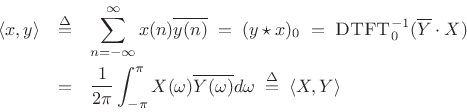
\begin{eqnarray*}
\left<x,y\right> &\isdef & \sum_{n=-\infty}^{\infty} x(n)\over...
...} X(\omega)\overline{Y(\omega)} d\omega
\isdef \left<X,Y\right>
\end{eqnarray*}


Order a Hardcopy of Spectral Audio Signal Processing

Previous: Autocorrelation
Next: Stretch Operator

written by Julius Orion Smith III
Julius Smith's background is in electrical engineering (BS Rice 1975, PhD Stanford 1983). He is presently Professor of Music and Associate Professor (by courtesy) of Electrical Engineering at Stanford's Center for Computer Research in Music and Acoustics (CCRMA), teaching courses and pursuing research related to signal processing applied to music and audio systems. See http://ccrma.stanford.edu/~jos/ for details.


Comments


No comments yet for this page


Add a Comment
You need to login before you can post a comment (best way to prevent spam). ( Not a member? )