Repeat (Scaling) Operator
We define the repeat operator in the frequency domain as
a scaling of frequency axis by some integer factor  :
:
 |
(3.30) |
where
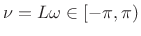 denotes the radian frequency variable after
applying the repeat operator.
denotes the radian frequency variable after
applying the repeat operator.
The repeat operator maps the entire unit circle (taken as  to
to
 ) to a segment of itself
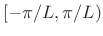 , centered about
 , and repeated
  times. This is illustrated in Fig.2.2
for
times. This is illustrated in Fig.2.2
for  .
.
![\begin{psfrags}
% latex2html id marker 7156\psfrag{w}{\Large $\omega$}\begin{figure}[htbp]
\includegraphics[width=\twidth]{eps/repeat2}
\caption{Illustration of the repeat operator.}
\end{figure}
\end{psfrags}](http://www.dsprelated.com/josimages_new/sasp2/img196.png)
Since the frequency axis is continuous and  -periodic for DTFTs,
the repeat operator is precisely equivalent to a scaling operator for
the Fourier transform case (§B.4). We call it ``repeat''
rather than ``scale'' because we are restricting the scale factor to
positive integers, and because the name ``repeat'' describes more
vividly what happens to a periodic spectrum that is compressively
frequency-scaled over the unit circle by an integer factor.
-periodic for DTFTs,
the repeat operator is precisely equivalent to a scaling operator for
the Fourier transform case (§B.4). We call it ``repeat''
rather than ``scale'' because we are restricting the scale factor to
positive integers, and because the name ``repeat'' describes more
vividly what happens to a periodic spectrum that is compressively
frequency-scaled over the unit circle by an integer factor.
Next Section:
Stretch/Repeat (Scaling) Theorem
Previous Section:
Stretch Operator