







Sample Variance
Definition:
The sample variance of a set of  samples from a particular
realization of a stationary stochastic process
samples from a particular
realization of a stationary stochastic process  is defined
as average squared magnitude after removing the known mean:
is defined
as average squared magnitude after removing the known mean:
 |
(C.20) |
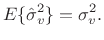
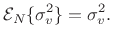
The sample variance is a unbiased estimator of the true variance when the mean is known, i.e.,
 |
(C.21) |
This is easy to show by taking the expected value:




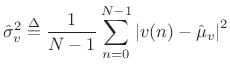
When the mean is unknown, the sample mean is used in its place:
 |
(C.23) |
The normalization by
 instead of
is necessary to make the
sample variance be an unbiased estimator of the true variance.
This adjustment is necessary because the sample mean is
correlated with the term
instead of
is necessary to make the
sample variance be an unbiased estimator of the true variance.
This adjustment is necessary because the sample mean is
correlated with the term  in the sample variance
expression. This is revealed by replacing
in the sample variance
expression. This is revealed by replacing  with
with
 in the
calculation of (C.22).
in the
calculation of (C.22).
Next Section:
Cross-Correlation
Previous Section:
Variance












