Sinc Impulse
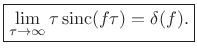
The preceding Fourier pair can be used to show that
 |
(B.35) |
Proof: The inverse Fourier transform of
 sinc
sinc is
is
![\begin{eqnarray*}
p_\tau(t)
&=& \ensuremath{\int_{-\infty}^{\infty}}\tau\,\mbox{sinc}\left(\frac{\omega}{2\pi}\tau\right) e^{j\omega t}\frac{d\omega}{2\pi}\\
&=& \ensuremath{\int_{-\infty}^{\infty}}\tau\,\mbox{sinc}(f\tau) e^{j2\pi f t}df\\
&=& \left\{\begin{array}{ll}
1, & \left\vert\tau\right\vert\leq 1/2 \\ [5pt]
0, & \mbox{otherwise}. \\
\end{array} \right.
\end{eqnarray*}](http://www.dsprelated.com/josimages_new/sasp2/img2476.png)
In particular, in the middle of the rectangular pulse at  , we have
 |
(B.36) |
This establishes that the algebraic area under
sinc is
1 for every
is
1 for every  . Every delta function (impulse) must have this
property.
. Every delta function (impulse) must have this
property.
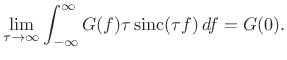
We now show that
sinc
also satisfies the sifting
property in the limit as
 . This property fully
establishes the limit as a valid impulse. That is, an impulse
. This property fully
establishes the limit as a valid impulse. That is, an impulse
 is any function having the property that
 |
(B.37) |
for every continuous function
 . In the present case, we need to
show, specifically, that
. In the present case, we need to
show, specifically, that
 |
(B.38) |
Define
 sinc
. Then by the power theorem
(§B.9),
sinc
. Then by the power theorem
(§B.9),
 |
(B.39) |
Then as
, the limit converges to the algebraic area
under  , which is
  as desired:
 |
(B.40) |
We have thus established that
 |
(B.41) |
where
sinc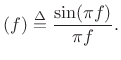 |
(B.42) |
For related discussion, see [36, p. 127].
Next Section:
Impulse Trains
Previous Section:
Rectangular Pulse