







Spectral Characteristics of Noise
As we know, the spectrum  of a time series
  has both
a magnitude
has both
a magnitude
 and a phase
 . The
phase of the spectrum gives information about when the signal
occurred in time. For example, if the phase is predominantly linear
with slope
. The
phase of the spectrum gives information about when the signal
occurred in time. For example, if the phase is predominantly linear
with slope  , then the signal must have a prominent pulse,
onset, or other transient, at time
, then the signal must have a prominent pulse,
onset, or other transient, at time  in the time domain.
For stationary noise signals, the spectral phase is simply
random, and therefore devoid of information. This happens
because stationary noise signals, by definition, cannot have special
``events'' at certain times (other than their usual random
fluctuations). Thus, an important difference between the spectra of
deterministic signals (like sinusoids) and noise signals is that the
concept of phase is meaningless for noise signals. Therefore,
when we Fourier analyze a noise sequence
, we will always
eliminate phase information by working with
 in the frequency domain (the squared-magnitude Fourier transform),
where
in the frequency domain (the squared-magnitude Fourier transform),
where
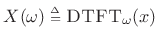 .
.
Next Section:
White Noise
Previous Section:
Introduction to Noise












