Summary of LP Spectral Envelopes
In summary, the spectral envelope of the  th spectral frame,
computed by linear prediction, is given by
th spectral frame,
computed by linear prediction, is given by
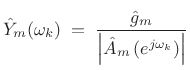 |
(11.13) |
where
 is computed from the solution of the Toeplitz normal
equations, and
is computed from the solution of the Toeplitz normal
equations, and
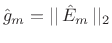 is the estimated rms level
of the prediction error in the
th frame.
is the estimated rms level
of the prediction error in the
th frame.
 |
(11.14) |
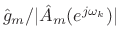
can be driven by unit-variance white noise to produce a filtered-white-noise signal having spectral envelope
 . We may regard
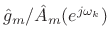 (no absolute value) as the frequency
response of the filter in a source-filter decomposition of the
signal
(no absolute value) as the frequency
response of the filter in a source-filter decomposition of the
signal  , where the source is white noise.
It bears repeating that
 is zero mean when
 is monic and minimum phase (all zeros inside the unit circle).
This means, for example, that
is monic and minimum phase (all zeros inside the unit circle).
This means, for example, that
 can be simply estimated as
the mean of the log spectral magnitude
can be simply estimated as
the mean of the log spectral magnitude
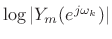 .
.
For best results, the frequency axis ``seen'' by linear prediction should be warped to an auditory frequency scale, as discussed in Appendix E [123]. This has the effect of increasing the accuracy of low-frequency peaks in the extracted spectral envelope, in accordance with the nonuniform frequency resolution of the inner ear.
Next Section:
Signal Synthesis
Previous Section:
Linear Prediction Order Selection