Summary of STFT Computation Using FFTs
- Read
 samples of the input signal
  into a local buffer of
length
into a local buffer of
length  which is initially zeroed

We call the
the  th frame of the input signal, and
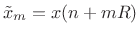 the
th time normalized input frame
(time-normalized by translating it to time zero). The frame length is
the
th time normalized input frame
(time-normalized by translating it to time zero). The frame length is
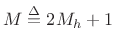 , which we assume to be odd for reasons to be
discussed later. The time advance
, which we assume to be odd for reasons to be
discussed later. The time advance  (in samples) from one frame to
the next is called the
hop size
or
step size.
(in samples) from one frame to
the next is called the
hop size
or
step size.
- Multiply the data frame pointwise by a length
spectrum
analysis window
 to obtain the
th
windowed data frame (time normalized):
to obtain the
th
windowed data frame (time normalized):

- Extend
 with zeros on both sides to obtain a
zero-padded frame:
with zeros on both sides to obtain a
zero-padded frame:
![$\displaystyle \tilde{x}_m^{w,z}(n) \isdef \left\{\begin{array}{ll} \tilde{x}_m^w(n), & \left\vert n\right\vert\leq M_h\isdef {\frac{M-1}{2}} \\ [5pt] 0, & M_h< n \leq {\frac{N}{2}}-1 \\ [5pt] 0, & -{\frac{N}{2}}\leq n < -M_h \\ \end{array} \right.$](http://www.dsprelated.com/josimages_new/sasp2/img1274.png)
(8.5)
where is chosen to be a power of two larger than
. The number
is chosen to be a power of two larger than
. The number
 is the
zero-padding factor.
As discussed in §2.5.3,
the zero-padding factor is the interpolation factor for the
spectrum, i.e., each FFT bin is replaced by
bins, interpolating
the spectrum using ideal bandlimited interpolation [264], where
the ``band'' in this case is the
-sample nonzero duration of
in the time domain.
is the
zero-padding factor.
As discussed in §2.5.3,
the zero-padding factor is the interpolation factor for the
spectrum, i.e., each FFT bin is replaced by
bins, interpolating
the spectrum using ideal bandlimited interpolation [264], where
the ``band'' in this case is the
-sample nonzero duration of
in the time domain.
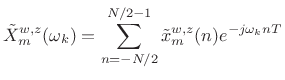
- Take a length
FFT of
 to obtain the time-normalized,
frequency-sampled STFT at time
:
to obtain the time-normalized,
frequency-sampled STFT at time
:
(8.6)
where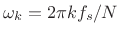 , and
, and  is the sampling rate in
Hz. As in any FFT, we call
is the sampling rate in
Hz. As in any FFT, we call  the bin number.
- If needed, time normalization may be removed using a
linear phase term to yield the sampled STFT:

(8.7)
The (continuous-frequency) STFT may be approached arbitrarily closely by using more zero padding and/or other interpolation methods.Note that there is no irreversible time-aliasing when the STFT frequency axis
 is sampled to the points
  , provided
the FFT size
is greater than or equal to the window length
.
, provided
the FFT size
is greater than or equal to the window length
.
Next Section:
Two Dual Interpretations of the STFT
Previous Section:
Practical Computation of the STFT