







Uniform Distribution
Among probability distributions  which are nonzero over a
finite range of values
which are nonzero over a
finite range of values ![$ x\in[a,b]$](http://www.dsprelated.com/josimages_new/sasp2/img2804.png) , the maximum-entropy
distribution is the uniform distribution. To show this, we
must maximize the entropy,
, the maximum-entropy
distribution is the uniform distribution. To show this, we
must maximize the entropy,
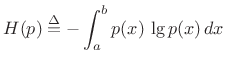 |
(D.33) |
with respect to
, subject to the constraints
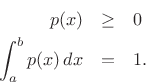
Using the method of Lagrange multipliers for optimization in the presence of constraints [86], we may form the objective function
 |
(D.34) |
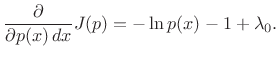
and differentiate with respect to
(and renormalize by dropping the  factor multiplying all terms) to obtain
 |
(D.35) |
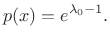
Setting this to zero and solving for
gives
 |
(D.36) |
(Setting the partial derivative with respect to
 to zero
merely restates the constraint.)
to zero
merely restates the constraint.)
Choosing
to satisfy the constraint gives
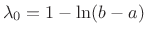 , yielding
![$\displaystyle p(x) = \left\{\begin{array}{ll} \frac{1}{b-a}, & a\leq x \leq b \\ [5pt] 0, & \hbox{otherwise}. \\ \end{array} \right.$](http://www.dsprelated.com/josimages_new/sasp2/img2812.png) |
(D.37) |
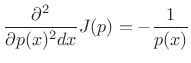
That this solution is a maximum rather than a minimum or inflection point can be verified by ensuring the sign of the second partial derivative is negative for all
 :
:
 |
(D.38) |
Since the solution spontaneously satisfied
 , it is a maximum.
Next Section:
Exponential Distribution
Previous Section:
Sample-Variance Variance












