Upsampling (Stretch) Operator
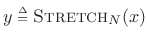 .
.
Figure 11.1 shows the graphical symbol for a digital upsampler
by the factor  . To upsample by the integer factor
, we simply
insert
. To upsample by the integer factor
, we simply
insert  zeros between
  and
and  for all
  . In other
words, the upsampler implements the stretch operator defined
in §2.3.9:
. In other
words, the upsampler implements the stretch operator defined
in §2.3.9:
![\begin{eqnarray*}
y(n) &=& \hbox{\sc Stretch}_{N,n}(x)\\
&\isdef & \left\{\begin{array}{ll}
x(n/N), & \frac{n}{N}\in{\bf Z} \\ [5pt]
0, & \hbox{otherwise}. \\
\end{array} \right.
\end{eqnarray*}](http://www.dsprelated.com/josimages_new/sasp2/img1924.png)
In the frequency domain, we have, by the stretch (repeat) theorem for DTFTs:
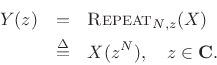
Plugging in
 , we see that the spectrum on
 contracts by the factor
, and
images appear around the
unit circle. For
contracts by the factor
, and
images appear around the
unit circle. For  , this is depicted in Fig.11.2.
 in the frequency domain.
![\includegraphics[width=0.8\twidth]{eps/upsampspec}](http://www.dsprelated.com/josimages_new/sasp2/img1927.png)
Next Section:
Downsampling (Decimation) Operator
Previous Section:
Optimal Band Filters