







Welch's Method
Welch's method [296] (also called the periodogram method) for estimating power spectra is carried out by dividing the time signal into successive blocks, forming the periodogram for each block, and averaging.
Denote the  th windowed, zero-padded frame from the signal
  by
by
 |
(7.26) |
where
 is defined as the window hop size, and let
  denote
the number of available frames. Then the periodogram of the
th
block is given by
denote
the number of available frames. Then the periodogram of the
th
block is given by

as before, and the Welch estimate of the power spectral density is given by
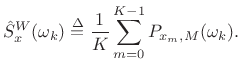
In other words, it's just an average of periodograms across time. When
 is the rectangular window, the periodograms are formed
from non-overlapping successive blocks of data. For other window
types, the analysis frames typically overlap, as discussed further in
§6.13 below.
is the rectangular window, the periodograms are formed
from non-overlapping successive blocks of data. For other window
types, the analysis frames typically overlap, as discussed further in
§6.13 below.
Welch Autocorrelation Estimate
Since
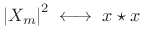 which is circular (or
cyclic) correlation, we must use zero padding in each FFT in
order to be able to compute the acyclic autocorrelation function as
the inverse DFT of the Welch PSD estimate. There is no need to
arrange the zero padding in zero-phase form, since all phase
information is discarded when the magnitude squared operation is
performed in the frequency domain.
which is circular (or
cyclic) correlation, we must use zero padding in each FFT in
order to be able to compute the acyclic autocorrelation function as
the inverse DFT of the Welch PSD estimate. There is no need to
arrange the zero padding in zero-phase form, since all phase
information is discarded when the magnitude squared operation is
performed in the frequency domain.
The Welch autocorrelation estimate is biased. That is, as
discussed in §6.6, it converges as
 to the true
autocorrelation
to the true
autocorrelation  weighted by
  (a Bartlett window). The
bias can be removed by simply dividing it out, as in
(6.15).
(a Bartlett window). The
bias can be removed by simply dividing it out, as in
(6.15).
Resolution versus Stability
A fundamental trade-off exists in Welch's method between
spectral resolution and statistical stability.
As discussed in §5.4.1, we wish to maximize the block size
 in order to maximize spectral resolution. On the other
hand, more blocks (larger
) gives more averaging and hence
greater spectral stability.
A typical default choice is
in order to maximize spectral resolution. On the other
hand, more blocks (larger
) gives more averaging and hence
greater spectral stability.
A typical default choice is
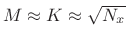 , where
  denotes the number of available data
samples.
denotes the number of available data
samples.
Next Section:
Welch's Method with Windows
Previous Section:
The Periodogram












