Welch's Method with Windows
As usual, the purpose of the window function  (Chapter 3)
is to reduce side-lobe level in the spectral
density estimate, at the expense of frequency resolution, exactly as
in the case of sinusoidal spectrum analysis.
(Chapter 3)
is to reduce side-lobe level in the spectral
density estimate, at the expense of frequency resolution, exactly as
in the case of sinusoidal spectrum analysis.
When using a non-rectangular analysis window, the window hop-size  cannot exceed half the frame length
  without introducing a
non-uniform sensitivity to the data
without introducing a
non-uniform sensitivity to the data  over time. In the
rectangular window case, we can set
over time. In the
rectangular window case, we can set  and have non-overlapping
windows. For Hamming, Hanning, and any other generalized Hamming
window, one normally sees
and have non-overlapping
windows. For Hamming, Hanning, and any other generalized Hamming
window, one normally sees 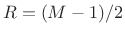 for odd-length windows. For the
Blackman window,
for odd-length windows. For the
Blackman window,
 is typical. In general, the hop size
is chosen so that the analysis window
is typical. In general, the hop size
is chosen so that the analysis window  overlaps and adds
to a constant at that hop size. This consideration is explored more
fully in Chapter 8. An equivalent parameter
used by most matlab implementations is the overlap parameter
overlaps and adds
to a constant at that hop size. This consideration is explored more
fully in Chapter 8. An equivalent parameter
used by most matlab implementations is the overlap parameter
 .
.
Note that the number of blocks averaged in (6.27) increases
as
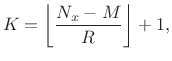
decreases. If  denotes the total number of signal
samples available, then the number of complete blocks available for
averaging may be computed as
denotes the total number of signal
samples available, then the number of complete blocks available for
averaging may be computed as
 |
(7.28) |
where the floor function
 denotes the largest integer less than or
equal to
denotes the largest integer less than or
equal to  .
.
Matlab for Welch's Method
Octave and the Matlab Signal Processing Toolbox have a pwelch function. Note that these functions also provide confidence intervals (not covered here). Matlab for generating the data shown in Fig.6.1 (employing Welch's method) appears in Fig.6.2.
M = 32; Ks=[1 8 32 128] nkases = length(Ks); for kase = 1:4 K = Ks(kase); N = M*K; Nfft = 2*M; % zero pad for acyclic autocorrelation Sv = zeros(Nfft,1); % PSD "accumulator" for m=1:K v = randn(M,1); % noise sample V = fft(v,Nfft); Vms = abs(V).^2; % same as conj(V) .* V Sv = Sv + Vms; % sum scaled periodograms end Sv = Sv/K; % average of all scaled periodograms rv = ifft(Sv); % Average Bartlett-windowed sample autocor. rvup = [rv(Nfft-M+1:Nfft)',rv(1:M)']; % unpack FFT rvup = rvup/M; % Normalize for no bias at lag 0 end |
Next Section:
Filtered White Noise
Previous Section:
Welch's Method