




Use Matlab Function pwelch to Find Power Spectral Density - or Do It Yourself
In this article, I'll present some examples to show how to use pwelch. You can also "do it yourself", i.e. compute spectra using the Matlab fft or other fft function. As examples, the appendix provides two demonstration mfiles; one computes the spectrum without DFT averaging, and the other computes the spectrum with DFT averaging.
Introduction to Digital Signal Processing
Nice slides introducing Digital Signal Processing.
Design IIR Butterworth Filters Using 12 Lines of Code
While there are plenty of canned functions to design Butterworth IIR filters [1], it's instructive and not that complicated to design them from scratch. You can do it in 12 lines of Matlab code.
Noise covariance properties in Dual-Tree Wavelet Decompositions
Dual-tree wavelet decompositions have recently gained much popularity, mainly due to their ability to provide an accurate directional analysis of images combined with a reduced redundancy. When the decomposition of a random process is performed – which occurs in particular when an additive noise is corrupting the signal to be analyzed – it is useful to characterize the statistical properties of the dual-tree wavelet coefficients of this process. As dual-tree decompositions constitute overcomplete frame expansions, correlation structures are introduced among the coefficients, even when a white noise is analyzed. In this paper, we show that it is possible to provide an accurate description of the covariance properties of the dual-tree coefficients of a wide-sense stationary process. The expressions of the (cross-) covariance sequences of the coefficients are derived in the one and two-dimensional cases. Asymptotic results are also provided, allowing to predict the behaviour of the second-order moments for large lag values or at coarse resolution. In addition, the crosscorrelations between the primal and dual wavelets, which play a primary role in our theoretical analysis, are calculated for a number of classical wavelet families. Simulation results are finally provided to validate these results.
Correlation and Power Spectrum
In the signals and systems course and in the first course in digital signal processing, a signal is, most often, characterized by its amplitude spectrum in the frequency-domain and its amplitude profile in the time-domain. So much a student gets used to this type of characterization, that the student finds it difficult to appreciate, when encountered in the ensuing statistical signal processing course, the fact that a signal can also be characterized by its autocorrelation function in the time-domain and the corresponding power spectrum in the frequency-domain and that the amplitude characterization is not available. In this article, the characterization of a signal by its autocorrelation function in the time-domain and the corresponding power spectrum in the frequency-domain is described. Cross-correlation of two signals is also presented.
Algorithms for Efficient Computation of Convolution
Convolution is an important mathematical tool in both fields of signal and image processing. It is employed in filtering, denoising, edge detection, correlation, compression, deconvolution, simulation, and in many other applications. Although the concept of convolution is not new, the efficient computation of convolution is still an open topic. As the amount of processed data is constantly increasing, there is considerable request for fast manipulation with huge data. Moreover, there is demand for fast algorithms which can exploit computational power of modern parallel architectures.
STUDY OF DIGITAL MODULATION TECHNIQUES
Modulation is the process of facilitating the transfer of information over a medium. Typically the objective of a digital communication system is to transport digital data between two or more nodes. In radio communications this is usually achieved by adjusting a physical characteristic of a sinusoidal carrier, either the frequency, phase, amplitude or a combination thereof . This is performed in real systems with a modulator at the transmitting end to impose the physical change to the carrier and a demodulator at the receiving end to detect the resultant modulation on reception. Hence, modulation can be objectively defined as the process of converting information so that it can be successfully sent through a medium. This thesis deals with the current digital modulation techniques used in industry. Also, the thesis examines the qualitative and quantitative criteria used in selection of one modulation technique over the other. All the experiments, and realted data collected were obtained using MATLAB and SIMULINK

Adaptive distributed noise reduction for speech enhancement in wireless acoustic sensor networks
An adaptive distributed noise reduction algorithm for speech enhancement is considered, which operates in a wireless acoustic sensor network where each node collects multiple microphone signals. In previous work, it was shown theoretically that for a stationary scenario, the algorithm provides the same signal estimators as the centralized multi-channel Wiener filter, while significantly compressing the data that is transmitted between the nodes. Here, we present simulation results of a fully adaptive implementation of the algorithm, in a non-stationary acoustic scenario with a moving speaker and two babble noise sources. The algorithm is implemented using a weighted overlap-add technique to reduce the overall input-output delay. It is demonstrated that good results can be obtained by estimating the required signal statistics with a long-term forgetting factor without downdating, even though the signal statistics change along with the iterative filter updates. It is also demonstrated that simultaneous node updating provides a significantly smoother and faster tracking performance compared to sequential node updating.
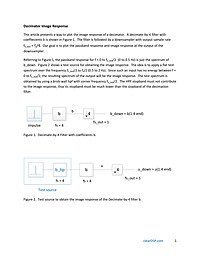
Decimator Image Response
This article presents a way to compute and plot the image response of a decimator. I'm defining the image response as the unwanted spectrum of the impulse response after downsampling, relative to the desired passband response.
Adaptive Algorithms in Digital Signal Processing - Overview, Theory and Applications
Introduction of C Programming for DSP Applications
Appendix C of the book : Real-Time Digital Signal Processing: Implementations, Application and Experiments with the TMS320C55X
An Introduction To Compressive Sampling
This article surveys the theory of compressive sensing, also known as compressed sensing or CS, a novel sensing/sampling paradigm that goes against the common wisdom in data acquisition.
Introduction to Compressed Sensing
Chapter 1 of the book: "Compressed Sensing: Theory and Applications".
C++ Tutorial
This tutorial is for those people who want to learn programming in C++ and do not necessarily have any previous knowledge of other programming languages. Of course any knowledge of other programming languages or any general computer skill can be useful to better understand this tutorial, although it is not essential. It is also suitable for those who need a little update on the new features the language has acquired from the latest standards. If you are familiar with the C language, you can take the first 3 parts of this tutorial as a review of concepts, since they mainly explain the C part of C++. There are slight differences in the C++ syntax for some C features, so I recommend you its reading anyway. The 4th part describes object-oriented programming. The 5th part mostly describes the new features introduced by ANSI-C++ standard.
Introduction to Sound Processing
Audio signal processing with MATLAB and Octave code examples.
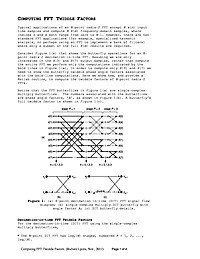
Computing FFT Twiddle Factors
In this document are two algorithms showing how to compute the individual twiddle factors of an N-point decimation-in-frequency (DIF) and an N-point decimation-in-time (DIT) FFT.
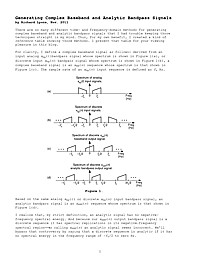
Generating Complex Baseband and Analytic Bandpass Signals
There are so many different time- and frequency-domain methods for generating complex baseband and analytic bandpass signals that I had trouble keeping those techniques straight in my mind. Thus, for my own benefit, I created a kind of reference table showing those methods. I present that table for your viewing pleasure in this document.
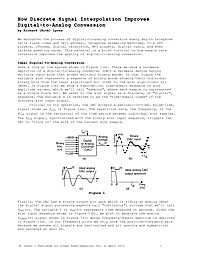
How Discrete Signal Interpolation Improves D/A Conversion
Earlier this year, for the Linear Audio magazine, published in the Netherlands whose subscribers are technically-skilled hi-fi audio enthusiasts, I wrote an article on the fundamentals of interpolation as it's used to improve the performance of analog-to-digital conversion. Perhaps that article will be of some value to the subscribers of dsprelated.com. Here's what I wrote: We encounter the process of digital-to-analog conversion every day—in telephone calls (land lines and cell phones), telephone answering machines, CD & DVD players, iPhones, digital television, MP3 players, digital radio, and even talking greeting cards. This material is a brief tutorial on how sample rate conversion improves the quality of digital-to-analog conversion.
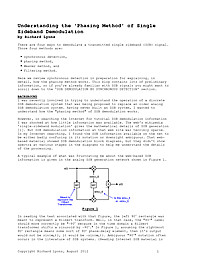
Understanding the 'Phasing Method' of Single Sideband Demodulation
There are four ways to demodulate a transmitted single sideband (SSB) signal. Those four methods are: synchronous detection, phasing method, Weaver method, and filtering method. Here we review synchronous detection in preparation for explaining, in detail, how the phasing method works. This blog contains lots of preliminary information, so if you're already familiar with SSB signals you might want to scroll down to the 'SSB DEMODULATION BY SYNCHRONOUS DETECTION' section.
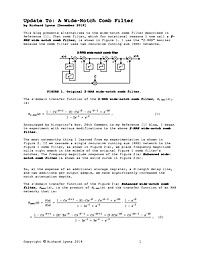
Update To: A Wide-Notch Comb Filter
This article presents alternatives to the wide-notch comb filter described in Reference [1].
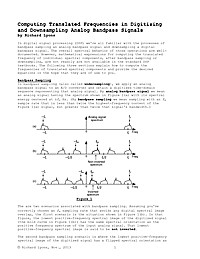
Computing Translated Frequencies in Digitizing and Downsampling Analog Bandpass Signals
In digital signal processing (DSP) we're all familiar with the processes of bandpass sampling an analog bandpass signal and downsampling a digital bandpass signal. The overall spectral behavior of those operations are well-documented. However, mathematical expressions for computing the translated frequency of individual spectral components, after bandpass sampling or downsampling, are not available in the standard DSP textbooks. This document explains how to compute the frequencies of translated spectral components and provide the desired equations in the hope that they are of use to you.
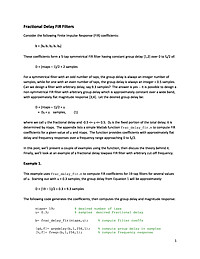
Fractional Delay FIR Filters
Consider the following Finite Impulse Response (FIR) coefficients:
b = [b0 b1 b2 b1 b0]
These coefficients form a 5-tap symmetrical FIR filter having constant group delay [1,2] over 0 to fs/2 of:
D = (ntaps - 1)/2 = 2 samples
For a symmetrical filter with an odd number of taps, the group delay is always an integer number of samples, while for one with an even number of taps, the group delay is always an integer + 0.5 samples. Can we design a filter with arbitrary delay, say 9.3 samples? The answer is yes -- It is possible to design a non-symmetrical FIR filter with arbitrary group delay which is approximately constant over a wide band, with approximately flat magnitude response [3,4]. Let the desired group delay be:
D = (ntaps - 1)/2 + u
= D0 + u samples, (1)
where we call u the fractional delay and -0.5 <= u <= 0.5. D0 is the fixed portion of the total delay; it is determined by ntaps. The appendix lists a simple Matlab function frac_delay_fir.m to compute FIR coefficients for a given value of u and ntaps. The function provides coefficients with approximately flat delay and frequency responses over a frequency range approaching 0 to fs/2.
In this post, we'll present a couple of examples using the function, then discuss the theory behind it. Finally, we'll look at an example of a fractional delay lowpass FIR filter with arbitrary cut-off frequency.
Cascaded Integrator-Comb (CIC) Filter Introduction
In the classic paper, "An Economical Class of Digital Filters for Decimation and Interpolation", Hogenauer introduced an important class of digital filters called "Cascaded Integrator-Comb", or "CIC" for short (also sometimes called "Hogenauer filters"). Here, Matthew Donadio provides a more gentle introduction to the subject of CIC filters, geared specifically to the needs of practicing DSP designers.
A Simplified Matlab Function for Power Spectral Density
In an earlier post, I showed how to compute power spectral density (PSD) of a discrete-time signal using the Matlab function pwelch. Pwelch is a useful function because it gives the correct output, and it has the option to average multiple Discrete Fourier Transforms (DFTs). However, a typical function call has five arguments, and it can be hard to remember how to set them all and how they default.
In this post, I create a simplified PSD function by putting a wrapper on pwelch that sets some parameters and converts the output units from W/Hz to dBW/bin. The function is named psd_simple.m, and its code is listed in the appendix.
Introduction to Compressed Sensing
Chapter 1 of the book: "Compressed Sensing: Theory and Applications".
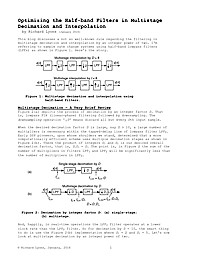
Optimizing the Half-band Filters in Multistage Decimation and Interpolation
This article discusses a not so well-known rule regarding the filtering in multistage decimation and interpolation by an integer power of two.
Generating Complex Baseband and Analytic Bandpass Signals
There are so many different time- and frequency-domain methods for generating complex baseband and analytic bandpass signals that I had trouble keeping those techniques straight in my mind. Thus, for my own benefit, I created a kind of reference table showing those methods. I present that table for your viewing pleasure in this document.
Optimization of Synthesis Oversampled Complex Filter Banks
An important issue with oversampled FIR analysis filter banks (FBs) is to determine inverse synthesis FBs, when they exist. Given any complex oversampled FIR analysis FB, we first provide an algorithm to determine whether there exists an inverse FIR synthesis system. We also provide a method to ensure the Hermitian symmetry property on the synthesis side, which is serviceable to processing real-valued signals. As an invertible analysis scheme corresponds to a redundant decomposition, there is no unique inverse FB. Given a particular solution, we parameterize the whole family of inverses through a null space projection. The resulting reduced parameter set simplifies design procedures, since the perfect reconstruction constrained optimization problem is recast as an unconstrained optimization problem. The design of optimized synthesis FBs based on time or frequency localization criteria is then investigated, using a simple yet efficient gradient algorithm.
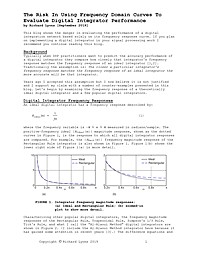
The Risk In Using Frequency Domain Curves To Evaluate Digital Integrator Performance
This article shows the danger in evaluating the performance of a digital integration network based solely on its frequency response curve. If you plan on implementing a digital integrator in your signal processing work I recommend you continue reading this article.