Harmonic Notch Filter
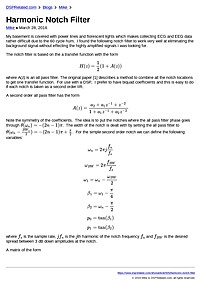
My basement is covered with power lines and florescent lights which makes collecting ECG and EEG data rather difficult due to the 60 cycle hum. I found the following notch filter to work very well at eliminating the background signal...

Summary
This blog describes a practical harmonic notch filter approach for removing 60 Hz mains hum (and its harmonics) from low-amplitude biosignals such as ECG and EEG. It explains filter choices, implementation tips, and simple FFT checks so readers can design, tune, and verify notch/comb and adaptive filters for real recordings.
Key Takeaways
- Design a stable IIR biquad notch (single-frequency) and extend to comb filters for harmonic suppression.
- Tune Q and bandwidth to balance mains attenuation against signal distortion and ringing.
- Use FFT-based spectral analysis to locate harmonics and verify notch effectiveness.
- Implement zero-phase (forward-backward) filtering or an adaptive LMS notch when the hum is nonstationary.
Who Should Read This
Intermediate engineers or researchers processing biomedical, audio, or low-amplitude signals who need practical methods to remove mains hum and harmonics from recordings.
Still RelevantIntermediate
Related Documents
- A New Approach to Linear Filtering and Prediction Problems TimelessAdvanced
- A Quadrature Signals Tutorial: Complex, But Not Complicated TimelessIntermediate
- Lecture Notes on Elliptic Filter Design TimelessAdvanced
- Computing FFT Twiddle Factors TimelessAdvanced
- Digital Envelope Detection: The Good, the Bad, and the Ugly TimelessIntermediate