Implementing Impractical Digital Filters
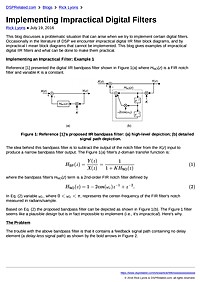
This blog discusses a problematic situation that can arise when we try to implement certain digital filters. Occasionally in the literature of DSP we encounter impractical digital IIR filter block diagrams, and by impractical I mean block...

Summary
This blog explains why some published IIR filter block diagrams are impractical to implement and how those pitfalls show up in real systems. It guides the reader to detect problematic structures and apply robust realizations, coefficient scaling, and simulation checks (e.g., MATLAB/Simulink) to make filters implementable in real-time DSP.
Key Takeaways
- Identify common impractical IIR block-diagram constructs and the reasons they fail in implementation
- Analyze numerical issues such as pole-zero cancellation, coefficient sensitivity, and limit-cycle behavior
- Choose robust realizations (cascade, lattice, or state-space) to improve stability and reduce sensitivity
- Apply fixed-point scaling, coefficient quantization strategies, and overflow controls to avoid implementation artifacts
- Use MATLAB/Simulink-based simulation and testing workflows to validate practical implementations before deployment
Who Should Read This
Embedded DSP engineers, algorithm developers, or signal-processing practitioners with experience implementing IIR filters who need to recognize impractical block diagrams and choose robust realizations for real-time systems.
TimelessAdvanced
Related Documents
- Lecture Notes on Elliptic Filter Design TimelessAdvanced
- Computing FFT Twiddle Factors TimelessAdvanced
- Digital Envelope Detection: The Good, the Bad, and the Ugly TimelessIntermediate
- The World's Most Interesting FIR Filter Equation: Why FIR Filters Can Be Line... TimelessAdvanced
- A Beginner's Guide To Cascaded Integrator-Comb (CIC) Filters TimelessBeginner