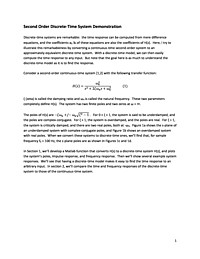
Second Order Discrete-Time System Demonstration
Discrete-time systems are remarkable: the time response can be computed from mere difference equations, and the coefficients ai, bi of these equations are also the coefficients of H(z). Here, I try to illustrate this remarkableness by converting a continuous-time second-order system to an approximately equivalent discrete-time system. With a discrete-time model, we can then easily compute the time response to any input. But note that the goal here is as much to understand the discrete-time model as it is to find the response.

Summary
Neil Robertson's 2020 blog demonstrates how to convert a continuous-time second-order system into an approximately equivalent discrete-time model and then compute time responses from the resulting difference equations. The article emphasizes understanding the relationship between the difference-equation coefficients and the H(z) representation, and illustrates pole-zero mapping, stability, and time-domain simulation.
Key Takeaways
- Derive an approximate discrete-time model from a continuous-time second-order system using standard discretization methods (e.g., bilinear transform and impulse invariance).
- Compute impulse and step responses directly from the discrete difference equation coefficients (ai, bi) and interpret time-domain behavior.
- Map poles and zeros between the s-plane and z-plane to assess stability, damping, and frequency warping effects.
- Formulate H(z) from difference-equation coefficients and verify frequency-response characteristics using simulation (examples suitable for MATLAB/Simulink).
Who Should Read This
Intermediate DSP or control engineers and graduate students who want practical insight into discretization methods and time-domain analysis of second-order systems.
TimelessIntermediate
Related Documents
- A New Approach to Linear Filtering and Prediction Problems TimelessAdvanced
- Lecture Notes on Elliptic Filter Design TimelessAdvanced
- Computing FFT Twiddle Factors TimelessAdvanced
- Digital Envelope Detection: The Good, the Bad, and the Ugly TimelessIntermediate
- The World's Most Interesting FIR Filter Equation: Why FIR Filters Can Be Line... TimelessAdvanced