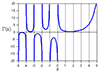





You don't have to go that far. I used to take it for granted that given x and y, I could draw a graph of x vs. y. How to even think about doing that if both are complex quantities boggles me.

Jerry
--
Engineering is the art of making what you want from things you can get.

Online · Live + on demand
February 9-11, 2027
Price goes up Jan 1: register now to lock in today's rate
Register Now →
Calibrating FFT results, amplitude in to magnitude out
Started by ●March 25, 2011
Reply by ●April 1, 20112011-04-01
Reply by ●April 1, 20112011-04-01
On 4/1/2011 1:58 PM, Jerry Avins wrote:> You don't have to go that far. I used to take it for granted that given x and y, I could draw a graph of x vs. y. How to even think about doing that if both are complex quantities boggles me. > > JerryWell, in the abstract, if that's what more than 3 dimensions should be called, it makes it easier for me to see that complex x and complex y are different than vectors in only x and y. I had been mixing them up. I still don't know any application for such things but in concept it makes sense I think.... Fred
Reply by ●April 1, 20112011-04-01
On Apr 1, 3:58�pm, Jerry Avins <j...@ieee.org> wrote:> You don't have to go that far. I used to take it for granted that given x and y, I could draw a graph of x vs. y. How to even think about doing that if both are complex quantities boggles me. >I read in some book that in the Laplace transform H(s) = 1/(s+1), s is supposed to be a complex variable and that H(s) has something called a pole at s = -1. It even had a 3-D picture of sorts showing a tall chimney at what I could have sworn was the point (-1,0) in the x-y plane except they were calling the axes sigma and omega for some strange reason. I am so confused. If s is a complex number, isn't 1/(s+1) = H(s) also a complex number? So what's that tall chimney, and how do I plot H(s) as a function of s? --Dilip Confused
Reply by ●April 2, 20112011-04-02
On Apr 1, 5:25�pm, robert bristow-johnson <r...@audioimagination.com> wrote:> On Apr 1, 7:50�am, illywhacker <illywac...@gmail.com> wrote: > > > > > > > On Mar 31, 11:02�pm, Jerry Avins <j...@ieee.org> wrote: > > > > I know I'm coming in late, but I've been away all day. I haven't read the rest of the thread yet. Please excuse me if that turns out to be a mistake. > > > > On Wednesday, March 30, 2011 11:48:09 PM UTC-4, robert bristow-johnson wrote: > > > > On Mar 30, 1:51 pm, Fred Marshall <fmarshallxr...@acm.org> > > > > wrote: > > > > > > Well, I believe all that. �It's just more information about a physical > > > > > reality. �You're very clear it's about a phase shift - which is clearly > > > > > a real thing. > > > > > > I think what you're describing is the *handy notation* that ends up > > > > > using 2-dimensional numbers/vectors .. whatever. �We label one dimension > > > > > "real" (unfortunately) and the other dimension "imaginary" > > > > > (unfortunately) and call the combinations of them "complex" which may be > > > > > OK but is just another term for "2-dimensional". > > > > > no, it's *not* just another dimension like y is to x. �in empty space, > > > > there is no qualitative difference between x, y, and z. �there *is* a > > > > qualitative difference between the real and imaginary axes and it > > > > isn't just because of the labels. > > > > What is that difference, then? In the s plane, one axis represents frequency and the other, gain. The only reason co call one imaginary has to do with the way we do the math. > > > They are just names Jerry, mere labels! They could be called the red > > axis and the blue axis. > > so when we measure or describe quantity in physical reality, they are > "blue numbers"? �maybe, instead, we should call it "physical > blueality"Might as well. The word 'reality' is pretty much content-free anyway. While I agree that there is a difference algebraically between the real numbers and the imaginary numbers, as I have said in other posts (the most obvious difference being that the imaginary numbers are not a subalgebra), I do not agree that the arbitrary and historically determined labels 'real' and 'imaginary' have any deeper meaning. A wave function is a complex object, and this is surely an element of reality. I am aware that observables are represented by Hermitian operators, and hence real eigenvalues, but the explanation for this is surely not that 'we can only measure real numbers'. First, we would only have to multiply all the operators by i to get anti-Hermitain operators, and suppose that our measuring devices measure imaginary numbers. Second, we do not 'measure real numbers'. Real numbers are limit objects, and can never be specified exactly. The things we measure are members of finite sets, so you could say they are natural numbers. But this would be miseading too, because a measurement actually consists of an isomorphism between one finite set and another - a correspondence - as when we count something. illywhacker;
Reply by ●April 2, 20112011-04-02
On Apr 1, 9:29�pm, dvsarwate <dvsarw...@yahoo.com> wrote:> On Apr 1, 3:58�pm, Jerry Avins <j...@ieee.org> wrote: > > > You don't have to go that far. I used to take it for granted that given x and y, I could draw a graph of x vs. y. How to even think about doing that if both are complex quantities boggles me. > > I read in some book that in the Laplace transform H(s) = 1/(s+1), > s is supposed to be a complex variable and that H(s) has something > called a pole at s = -1. �It even had a 3-D picture of sorts showing > a tall chimney at what I could have sworn was the point (-1,0) in > the x-y plane except they were calling the axes sigma and omega for > some strange reason. �I am so confused. �If s is a complex number, > isn't 1/(s+1) = H(s) also a complex number? �So what's that tall > chimney, and how do I plot H(s) as a function of s? > > --Dilip ConfusedApril 1, right? r b-j
Reply by ●April 2, 20112011-04-02
On 4/2/2011 2:54 AM, illywhacker wrote:> A > wave function is a complex object,Looks like a good example. From Wikipedia: "... is a function from a space that maps the possible states of the system into the complex numbers." So, I think, we are perhaps once more looking at real numbers (the states) in a complex context after the mapping. But, I can't directly interpret the author's meaning of: "The spatial wave function associated with a particle in one dimension is ***a complex function defined over the real line***." [***emphasis added***] I would think that this means the same sort of thing as a general plot of the roots of a polynomial in say "x" where the polynomial is real, the factored polynomial has complex and real roots, the x (re and im) axes are prominent in the plot or visualization of the roots with emphasis on the Real in that sentence above. The Wikipedia page on Hilbert Space is interesting... Fred
Reply by ●April 2, 20112011-04-02
On Apr 2, 5:54�am, illywhacker <illywac...@gmail.com> wrote:> On Apr 1, 5:25�pm, robert bristow-johnson <r...@audioimagination.com> > wrote: > > > > > On Apr 1, 7:50�am, illywhacker <illywac...@gmail.com> wrote: > > > > On Mar 31, 11:02�pm, Jerry Avins <j...@ieee.org> wrote: > ... > > > > What is that difference, then? In the s plane, one axis represents frequency and the other, gain. The only reason co call one imaginary has to do with the way we do the math. > > > > They are just names Jerry, mere labels! They could be called the red > > > axis and the blue axis. > > > so when we measure or describe quantity in physical reality, they are > > "blue numbers"? �maybe, instead, we should call it "physical > > blueality" > > Might as well. The word 'reality' is pretty much content-free anyway.maybe this is all an illusion. maybe we're just a simulation running in some cosmic computer and none of this is real. or our brains are on life-support in some mad scientists laboratory and he's just poking us with simulus.> While I agree that there is a difference algebraically between the > real numbers and the imaginary numbers, as I have said in other postsand i thank you for saying so.> (the most obvious difference being that the imaginary numbers are not > a subalgebra), I do not agree that the arbitrary and historically > determined labels 'real' �and 'imaginary' have any deeper meaning.okay. but i still don't expect anyone to place two leads of an analog voltmeter and read 3.6*i volts. i don't expect anyone to use a stopwatch to measure 10*i seconds, nor do i expect anyone to measure the length of anything as an imaginary number.> A wave function is a complex object, and this is surely an element of > reality.it's an abstraction that is related to reality. just as phasors are to EEs.> I am aware that observables are represented by Hermitian > operators, and hence real eigenvalues, but the explanation for this is > surely not that 'we can only measure real numbers'. First, we would > only have to multiply all the operators by i to get anti-Hermitain > operators, and suppose that our measuring devices measure imaginary > numbers. Second, we do not 'measure real numbers'. Real numbers are > limit objects, and can never be specified exactly.oh? i think they can, but it's real physical measurements that cannot be made exactly.> The things we > measure are members of finite sets, so you could say they are natural > numbers. But this would be miseading too, because a measurement > actually consists of an isomorphism between one finite set and another > - a correspondence - as when we count something.we measure and *describe* physical quantity with real numbers. it appears to me that we measure physical quantity with numbers that are real and rational. listen, i don't know anything about quantum mechanics that i didn't get as a sophomore or junior in college. while the underlying equations describing the wave equation is complex valued, i know that the expectation values are used to make a prediction of what we might observe are real values. they have to be. i know that complex values are used, at an abstract level, to describe other physical processes. in electrical engineering and signal processing, we do it a lot with "phasors". but they're abstractions. they represent a sinusoidal function of a *real* voltage at a *real* time. sorry, illy. nothing you said has made a dent in this. all of the physical quantities we measure and experience are numbers that eventually became known as "real numbers". it's an appropriate label. r b-j
Reply by ●April 2, 20112011-04-02
On Apr 2, 5:15�pm, Fred Marshall <fmarshallxremove_th...@acm.org> wrote:> > "The spatial wave function associated with a particle in one dimension > is ***a complex function defined over the real line***."This means that the function takes a real number as input and produces a complex number as output. illywhacker;
Reply by ●April 2, 20112011-04-02
On Apr 2, 5:57�pm, robert bristow-johnson <r...@audioimagination.com> wrote:> On Apr 2, 5:54�am, illywhacker <illywac...@gmail.com> wrote: > > > > > > > On Apr 1, 5:25�pm, robert bristow-johnson <r...@audioimagination.com> > > wrote: > > > > On Apr 1, 7:50�am, illywhacker <illywac...@gmail.com> wrote: > > > > > On Mar 31, 11:02�pm, Jerry Avins <j...@ieee.org> wrote: > > ... > > > > > What is that difference, then? In the s plane, one axis represents frequency and the other, gain. The only reason co call one imaginary has to do with the way we do the math. > > > > > They are just names Jerry, mere labels! They could be called the red > > > > axis and the blue axis. > > > > so when we measure or describe quantity in physical reality, they are > > > "blue numbers"? �maybe, instead, we should call it "physical > > > blueality" > > > Might as well. The word 'reality' is pretty much content-free anyway. > > maybe this is all an illusion. �maybe we're just a simulation running > in some cosmic computer and none of this is real. �or our brains are > on life-support in some mad scientists laboratory and he's just poking > us with simulus. > > > While I agree that there is a difference algebraically between the > > real numbers and the imaginary numbers, as I have said in other posts > > and i thank you for saying so. > > > (the most obvious difference being that the imaginary numbers are not > > a subalgebra), I do not agree that the arbitrary and historically > > determined labels 'real' �and 'imaginary' have any deeper meaning. > > okay. �but i still don't expect anyone to place two leads of an analog > voltmeter and read 3.6*i volts. �i don't expect anyone to use a > stopwatch to measure 10*i seconds, nor do i expect anyone to measure > the length of anything as an imaginary number. > > > A wave function is a complex object, and this is surely an element of > > reality. > > it's an abstraction that is related to reality. �just as phasors are > to EEs. > > > I am aware that observables are represented by Hermitian > > operators, and hence real eigenvalues, but the explanation for this is > > surely not that 'we can only measure real numbers'. First, we would > > only have to multiply all the operators by i to get anti-Hermitain > > operators, and suppose that our measuring devices measure imaginary > > numbers. Second, we do not 'measure real numbers'. Real numbers are > > limit objects, and can never be specified exactly. > > oh? �i think they can, but it's real physical measurements that cannot > be made exactly. > > > The things we > > measure are members of finite sets, so you could say they are natural > > numbers. But this would be miseading too, because a measurement > > actually consists of an isomorphism between one finite set and another > > - a correspondence - as when we count something. > > we measure and *describe* physical quantity with real numbers. �it > appears to me that we measure physical quantity with numbers that are > real and rational. > > listen, i don't know anything about quantum mechanics that i didn't > get as a sophomore or junior in college. �while the underlying > equations describing the wave equation is complex valued, i know that > the expectation values are used to make a prediction of what we might > observe are real values. �they have to be. �i know that complex values > are used, at an abstract level, to describe other physical processes. > in electrical engineering and signal processing, we do it a lot with > "phasors". �but they're abstractions. they represent a sinusoidal > function of a *real* voltage at a *real* time. > > sorry, illy. �nothing you said has made a dent in this. �all of the > physical quantities we measure and experience are numbers that > eventually became known as "real numbers". �it's an appropriate label.But real numers are an abstraction too; this is the point you are missing I think. The results of a measurement is inevitably, due to our finite abilities, an element of a finite set. So when you say the results of measurements are represented by real numbers, this is only because the actual measurement process is not being described: rather, an underlying 'true value' is being invoked that, while very convenient, has no operational status at all, just as imaginary numbers do not. illywhacker;
Reply by ●April 2, 20112011-04-02
I'm happy to call them blue numbers, or whatever you please. Sometimes my mind wanders and goes off on a tangent. At such times, when I say "Soon", I might mean about 2+i1/3 minutes. When I'm grounded, I leave out the part after the plus sign.

Jerry
--
Engineering is the art of making what you want from things you can get.