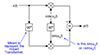





Oli Filth wrote:>>>> +------+ >> ---+--->| z^-L |-------------------+ >> | +------+ | >> | | >> | +------------+ | >> +------------->|+ -|<--+ >> | accumulate |-----> >> +------------+ >> > > Ah! Much clearer. :) > > Then yes, this *is* of course an equivalent system. > > To go back to your point on complexity, the accumulator-based system is > an in-place implementation the unit-length delay line, so requires maybe > one less register move, and so you're right, it's marginally less > complex. Behaviourally however, they're identical.Yes. I hate it when I don't communicate clearly. Thanks for your patience. Jerry -- Engineering is the art of making what you want from things you can get. �����������������������������������������������������������������������

Online · Live + on demand
February 9-11, 2027
Price goes up Nov 1: register now to lock in today's rate
Register Now →
Question on pole-zero cancellation
Started by ●June 7, 2006
Reply by ●June 11, 20062006-06-11
Reply by ●June 12, 20062006-06-12
Randy Yates wrote:> Andor wrote: > >[...] > > Hi Andor, > > I just came up with a problem with this analysis. Consider the unit > step function, u(t). It has a "point-mass" component in the frequency > domain at DC: > > U(w) = 1/(j*w) + pi*delta(w). > > However, it will pass through such a cascaded system (even a > theoretical one) without a problem, will it not?Hi Randy, I nearly missed this post with all the clatter going on here. Yes, you are right (good thinking!). The same problem occurs with sinusoids multiplied by the step function. It does not seem so easy to multiply point masses by zero after all :-). Perhaps one has to take the "sidedness" of the time-domain signal into account. It definitely requires more tought! Regards, Andor> > --Randy
Reply by ●June 16, 20062006-06-16
Andor wrote:> Randy Yates wrote: > > Andor wrote: > > >[...] > > > > Hi Andor, > > > > I just came up with a problem with this analysis. Consider the unit > > step function, u(t). It has a "point-mass" component in the frequency > > domain at DC: > > > > U(w) = 1/(j*w) + pi*delta(w). > > > > However, it will pass through such a cascaded system (even a > > theoretical one) without a problem, will it not? > > Hi Randy, > > I nearly missed this post with all the clatter going on here. Yes, you > are right (good thinking!). The same problem occurs with sinusoids > multiplied by the step function. It does not seem so easy to multiply > point masses by zero after all :-). Perhaps one has to take the > "sidedness" of the time-domain signal into account. It definitely > requires more tought!For you, it's "more thought" - for me, it's "two more graduate level mathematics courses." What recent, graduate-level math have you taken, Andor? It seems like this is in the "real analysis" and/or "functional analysis" area - it might be instructive to know more about where to think about learning more. --Randy