







Equation Error Formulation
The equation error is defined (in the frequency domain) as

By comparison, the more natural frequency-domain error is the so-called output error:
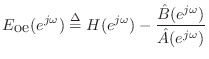
The names of these errors make the most sense in the time domain. Let
 and
and  denote the filter input and output, respectively, at time
 . Then the equation error is the error in the difference equation:

while the output error is the difference between the ideal and approximate filter outputs:
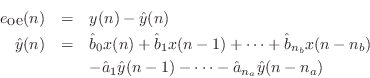
Denote the  norm of the equation error by

where
![$ \hat{\theta}^T = [\hat{b}_0,\hat{b}_1,\ldots,\hat{b}_{{n}_b}, \hat{a}_1,\ldots, \hat{a}_{{n}_a}]$](http://www.dsprelated.com/josimages_new/filters/img2401.png) is the
vector of unknown filter coefficients. Then the problem is to minimize
this norm with respect to
is the
vector of unknown filter coefficients. Then the problem is to minimize
this norm with respect to
 . What makes the equation-error so easy to
minimize is that it is linear in the parameters. In the time-domain
form, it is clear that the equation error is linear in the unknowns
. What makes the equation-error so easy to
minimize is that it is linear in the parameters. In the time-domain
form, it is clear that the equation error is linear in the unknowns
 . When the error is linear in the parameters, the sum of
squared errors is a quadratic form which can be minimized using one
iteration of Newton's method. In other words, minimizing the norm of
any error which is linear in the parameters results in a set of linear
equations to solve. In the case of the equation-error minimization at
hand, we will obtain
. When the error is linear in the parameters, the sum of
squared errors is a quadratic form which can be minimized using one
iteration of Newton's method. In other words, minimizing the norm of
any error which is linear in the parameters results in a set of linear
equations to solve. In the case of the equation-error minimization at
hand, we will obtain
 linear equations in as many unknowns.
Note that (I.11) can be expressed as

 . Thus, the weighting function is determined
by the filter poles, and the error is weighted less near the
poles. Since the poles of a good filter-design tend toward regions of
high spectral energy, or toward ``irregularities'' in the spectrum, it is
evident that the equation-error criterion assigns less importance to the
most prominent or structured spectral regions. On the other hand, far away
from the roots of
. Thus, the weighting function is determined
by the filter poles, and the error is weighted less near the
poles. Since the poles of a good filter-design tend toward regions of
high spectral energy, or toward ``irregularities'' in the spectrum, it is
evident that the equation-error criterion assigns less importance to the
most prominent or structured spectral regions. On the other hand, far away
from the roots of
 , good fits to both phase and magnitude can
be expected. The weighting effect can be eliminated through
use of the Steiglitz-McBride algorithm
[45,78] which iteratively solves the weighted
equation-error solution, using the canceling weight function from the
previous iteration. When it converges (which is typical in practice), it
must converge to the output error minimizer.
, good fits to both phase and magnitude can
be expected. The weighting effect can be eliminated through
use of the Steiglitz-McBride algorithm
[45,78] which iteratively solves the weighted
equation-error solution, using the canceling weight function from the
previous iteration. When it converges (which is typical in practice), it
must converge to the output error minimizer.
Next Section:
Error Weighting and Frequency Warping
Previous Section:
Examples












