







Q as Energy Stored over Energy Dissipated
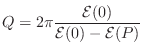
Yet another meaning for  is as follows [20, p. 326]

Proof. The total stored energy at time  is
equal to the total energy of the remaining response. After an impulse
at time 0, the stored energy in a second-order resonator is
is
equal to the total energy of the remaining response. After an impulse
at time 0, the stored energy in a second-order resonator is

 is
is
 , where
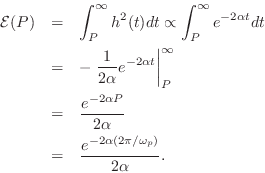
Assuming  as before,
 so that
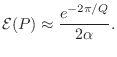
 , we obtain

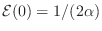 , gives
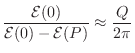
 , while
the one of the previous section only required .
, while
the one of the previous section only required .
Next Section:
Lossless Analog Filters
Previous Section:
Decay Time is Q Periods












