







Showing Linearity and Time Invariance, or Not
The filter
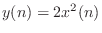 is nonlinear and time invariant. The
scaling property of linearity clearly fails since, scaling
is nonlinear and time invariant. The
scaling property of linearity clearly fails since, scaling  by
by
 gives the output signal
![$ 2[gx(n)]^2 = 2g^2x^2(n)$](http://www.dsprelated.com/josimages_new/filters/img463.png) , while
, while
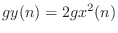 . The filter is time invariant, however, because delaying
  by
by  samples gives
  which is the same as
  .
.
The filter
 is linear and time varying.
We can show linearity by setting the input to a linear combination of
two signals
is linear and time varying.
We can show linearity by setting the input to a linear combination of
two signals
 , where
  and
and
 are constants:
![\begin{eqnarray*}
n [\alpha x_1(n) + \beta x_2(n)] &+& [\alpha x_1(n-1) + \beta ...
... [n x_2(n) + x_2(n-1)]\\
&\isdef & \alpha y_1(n) + \beta y_2(n)
\end{eqnarray*}](http://www.dsprelated.com/josimages_new/filters/img469.png)
Thus, scaling and superposition are verified. The filter is
time-varying, however, since the time-shifted output is
 which is not the same as the filter applied
to a time-shifted input (
which is not the same as the filter applied
to a time-shifted input (
 ). Note that in
applying the time-invariance test, we time-shift the input signal
only, not the coefficients.
). Note that in
applying the time-invariance test, we time-shift the input signal
only, not the coefficients.
The filter  , where
  is any constant, is nonlinear
and time-invariant, in general. The condition for time invariance is
satisfied (in a degenerate way) because a constant signal equals all
shifts of itself. The constant filter is technically linear,
however, for
is any constant, is nonlinear
and time-invariant, in general. The condition for time invariance is
satisfied (in a degenerate way) because a constant signal equals all
shifts of itself. The constant filter is technically linear,
however, for  , since
 , even though the input
signal has no effect on the output signal at all.
, even though the input
signal has no effect on the output signal at all.
Any filter of the form
 is linear and
time-invariant. This is a special case of a sliding linear
combination (also called a running weighted sum, or
moving average when
is linear and
time-invariant. This is a special case of a sliding linear
combination (also called a running weighted sum, or
moving average when
 ).
All sliding linear combinations are linear,
and they are time-invariant as well when the coefficients (
).
All sliding linear combinations are linear,
and they are time-invariant as well when the coefficients (
 ) are constant with respect to time.
Sliding linear combinations may also include past output samples as well (feedback terms). A simple example is any filter of the form

Since linear combinations of linear combinations are linear combinations, we can use induction to show linearity and time invariance of a constant sliding linear combination including feedback terms. In the case of this example, we have, for an input signal
starting at time zero,

If the input signal is now replaced by
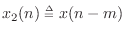 ,
which is delayed by samples, then the
output
,
which is delayed by samples, then the
output  is
is  for
for  , followed by
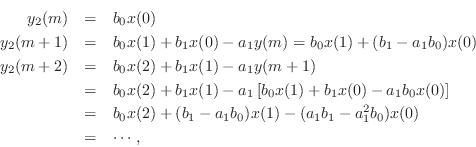
or
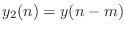 for all
  and
and  . This establishes
that each output sample from the filter of Eq.
. This establishes
that each output sample from the filter of Eq. (4.7) can be expressed
as a time-invariant linear combination of present and past samples.
(4.7) can be expressed
as a time-invariant linear combination of present and past samples.
Next Section:
Nonlinear Filter Example: Dynamic Range Compression
Previous Section:
Time-Invariant Filters











