Sign in

username:

password:


Not a member?

Search Online Books


Search tips

Free Online Books

Sponsor

Evaluate multicore with Texas Instruments:
Low-cost evaluation module & free software development kit available NOW.

Chapters

See Also

Embedded SystemsFPGAElectronics
Chapter Contents:

Search Mathematics of the DFT


Book Index | Global Index


Would you like to be notified by email when Julius Orion Smith III publishes a new entry into his blog?


Linearity of the Inner Product

Any function $ f(\underline{u})$ of a vector $ \underline{u}\in{\bf C}^N$ (which we may call an operator on $ {\bf C}^N$) is said to be linear if for all $ \underline{u}\in{\bf C}^N$ and $ \underline{v}\in{\bf C}^N$, and for all scalars $ \alpha$ and $ \beta $ in $ {\bf C}$,

$\displaystyle f(\alpha \underline{u}+ \beta \underline{v}) = \alpha f(\underline{u}) + \beta f(\underline{v}).
$

A linear operator thus ``commutes with mixing.'' Linearity consists of two component properties:
  • additivity: $ f(\underline{u}+\underline{v}) = f(\underline{u}) + f(\underline{v})$
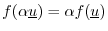
  • homogeneity: $ f(\alpha \underline{u}) = \alpha f(\underline{u})$
A function of multiple vectors, e.g., $ f(\underline{u},\underline{v},\underline{w})$ can be linear or not with respect to each of its arguments.

The inner product $ \left<\underline{u},\underline{v}\right>$ is linear in its first argument, i.e., for all $ \underline{u},\underline{v},\underline{w}\in{\bf C}^N$, and for all $ \alpha, \beta\in{\bf C}^N$,

$\displaystyle \left<\alpha \underline{u}+ \beta \underline{v},\underline{w}\rig...
...line{u},\underline{w}\right> + \beta \left<\underline{v},\underline{w}\right>.
$

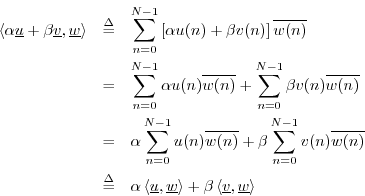
This is easy to show from the definition:

\begin{eqnarray*}
\left<\alpha \underline{u}+ \beta \underline{v},\underline{w}\...
...rline{w}\right> + \beta \left<\underline{v},\underline{w}\right>
\end{eqnarray*}

The inner product is also additive in its second argument, i.e.,

$\displaystyle \left<\underline{u},\underline{v}+ \underline{w}\right> = \left<\underline{u},\underline{v}\right> + \left<\underline{u},\underline{w}\right>,
$

but it is only conjugate homogeneous (or antilinear) in its second argument, since

$\displaystyle \left<\underline{u},\alpha \underline{v}\right> = \overline{\alph...
...{u},\underline{v}\right> \neq \alpha \left<\underline{u},\underline{v}\right>.
$

The inner product is strictly linear in its second argument with respect to real scalars $ a$ and $ b$:

$\displaystyle \left<\underline{u},a \underline{v}+ b \underline{w}\right> = a \...
...ne{v}\right> + b \left<\underline{u},\underline{w}\right>, \quad a,b\in{\bf R}
$

where $ \underline{u},\underline{v},\underline{w}\in{\bf C}^N$.

Since the inner product is linear in both of its arguments for real scalars, it may be called a bilinear operator in that context.


Previous: The Inner Product
Next: Norm Induced by the Inner Product

Order a Hardcopy of Mathematics of the DFT


About the Author: Julius Orion Smith III
Julius Smith's background is in electrical engineering (BS Rice 1975, PhD Stanford 1983). He is presently Professor of Music and Associate Professor (by courtesy) of Electrical Engineering at Stanford's Center for Computer Research in Music and Acoustics (CCRMA), teaching courses and pursuing research related to signal processing applied to music and audio systems. See http://ccrma.stanford.edu/~jos/ for details.


Comments


No comments yet for this page


Add a Comment
You need to login before you can post a comment (best way to prevent spam). ( Not a member? )