Projection
The orthogonal projection (or simply ``projection'') of
 onto
onto
 is defined by
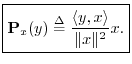
 is called the
coefficient of projection. When projecting
is called the
coefficient of projection. When projecting  onto a unit
length vector
onto a unit
length vector  , the coefficient of projection is simply the inner
product of with .
, the coefficient of projection is simply the inner
product of with .
Motivation: The basic idea of orthogonal projection of onto
is to ``drop a perpendicular'' from onto to define a new
vector along which we call the ``projection'' of onto .
This is illustrated for  in Fig.5.9 for
 ![$ x= [4,1]$](http://www.dsprelated.com/josimages_new/mdft/img878.png) and
and
![$ y=[2,3]$](http://www.dsprelated.com/josimages_new/mdft/img879.png) , in which case
, in which case
![$\displaystyle {\bf P}_{x}(y) \isdef \frac{\left<y,x\right>}{\Vert x\Vert^2} x
...
...{1})}{4^2+1^2} x
= \frac{11}{17} x= \left[\frac{44}{17},\frac{11}{17}\right].
$](http://www.dsprelated.com/josimages_new/mdft/img880.png)
![\includegraphics[scale=0.7]{eps/proj}](http://www.dsprelated.com/josimages_new/mdft/img881.png)
Derivation: (1) Since any projection onto must lie along the
line collinear with , write the projection as
 . (2) Since by definition the projection error
 is orthogonal to , we must have
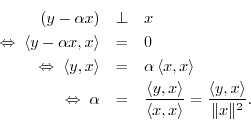
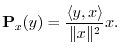
Thus,
See §I.3.3 for illustration of orthogonal projection in matlab.
Next Section:
Changing Coordinates
Previous Section:
The Pythagorean Theorem in N-Space