Sign in

username:

password:


Not a member?

Search Online Books


Search tips

Free Online Books

Sponsor

NEW! TMS320C6474: 3x the performance. 1/3 the cost. Three 1 GHz cores on 1 chip.

Chapters

Chapter Contents:

Search Mathematics of the DFT


Book Index | Global Index


Would you like to be notified by email when Julius Orion Smith III publishes a new entry into his blog?


Signal/Vector Reconstruction from Projections

We now arrive finally at the main desired result for this section:


Theorem: The projections of any vector $ x\in{\bf C}^N$ onto any orthogonal basis set for $ {\bf C}^N$ can be summed to reconstruct $ x$ exactly.


Proof: Let $ \{\sv_0,\ldots,\sv_{N-1}\}$ denote any orthogonal basis set for $ {\bf C}^N$. Then since $ x$ is in the space spanned by these vectors, we have

$\displaystyle x= \alpha_0\sv_0 + \alpha_1\sv_1 + \cdots + \alpha_{N-1}\sv_{N-1} \protect$ (5.3)

for some (unique) scalars $ \alpha_0,\ldots,\alpha_{N-1}$. The projection of $ x$ onto $ \sv_k$ is equal to

$\displaystyle {\bf P}_{\sv_k}(x) = \alpha_0{\bf P}_{\sv_k}(\sv_0) +
\alpha_1{\bf P}_{\sv_k}(\sv_1) + \cdots + \alpha_{N-1}{\bf P}_{\sv_k}(\sv_{N-1})
$

(using the linearity of the projection operator which follows from linearity of the inner product in its first argument). Since the basis vectors are orthogonal, the projection of $ \sv_l$ onto $ \sv_k$ is zero for $ l\neq k$:

$\displaystyle {\bf P}_{\sv_k}(\sv_l) \isdef
\frac{\left<\sv_l,\sv_k\right>}{\l...
...ay}{ll}
\underline{0}, & l\neq k \\ [5pt]
\sv_k, & l=k. \\
\end{array}\right.
$

We therefore obtain

$\displaystyle {\bf P}_{\sv_k}(x) = 0 + \cdots + 0 + \alpha_k{\bf P}_{\sv_k}(\sv_k) + 0 + \cdots + 0
= \alpha_k\sv_k.
$

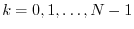
Therefore, the sum of projections onto the vectors $ \sv_k$, $ k=0,1,\ldots,
N-1$, is just the linear combination of the $ \sv_k$ which forms $ x$:

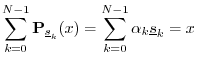
$\displaystyle \sum_{k=0}^{N-1}
{\bf P}_{\sv_k}(x) = \sum_{k=0}^{N-1} \alpha_k \sv_k = x
$

by Eq.$ \,$(5.3). $ \Box$


Order a Hardcopy of Mathematics of the DFT

Previous: General Conditions
Next: Gram-Schmidt Orthogonalization

written by Julius Orion Smith III
Julius Smith's background is in electrical engineering (BS Rice 1975, PhD Stanford 1983). He is presently Professor of Music and Associate Professor (by courtesy) of Electrical Engineering at Stanford's Center for Computer Research in Music and Acoustics (CCRMA), teaching courses and pursuing research related to signal processing applied to music and audio systems. See http://ccrma.stanford.edu/~jos/ for details.


Comments


No comments yet for this page


Add a Comment
You need to login before you can post a comment (best way to prevent spam). ( Not a member? )