Sign in

username:

password:


Not a member?

Search Online Books


Search tips

Free Online Books

Sponsor

Industry's highest performing at the lowest power DSPs now as low as $5.00*
Start development today!
*volume pricing for 10ku

Chapters

See Also

Embedded SystemsFPGAElectronics
Chapter Contents:

Search Physical Audio Signal Processing


Book Index | Global Index


Would you like to be notified by email when Julius Orion Smith III publishes a new entry into his blog?


Striking the Rod in the Middle

First, consider $ f(t,x)=\delta(t)\delta(x)$. That is, we apply an upward unit-force impulse at time 0 in the middle of the rod. The total momentum delivered in the neighborhood of $ x=0$ and $ t=0$ is obtained by integrating the applied force density with respect to time and position:

$\displaystyle p \eqsp \iint f(t,x)\,dt\,dx \eqsp \iint \delta(t)\delta(x)\,dt\,dx \eqsp 1
$

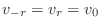
This unit momentum is transferred to the two masses $ m$. By symmetry, we have $ v_{-r} = v_r = v_0$. We can also refer to $ v_0$ as the velocity of the center of mass, again obvious by symmetry. Continuing to refer to Fig.B.5, we have

$\displaystyle p \eqsp 1 \eqsp mv_{-r} + mv_r \eqsp (2m)v_0 \,\,\Rightarrow\,\,v_0 \eqsp
\frac{1}{2m}.
$

Thus, after time zero, each mass is traveling upward at speed $ v_0=1/(2m)$, and there is no rotation about the center of mass at $ x=0$.

The kinetic energy of the system after time zero is

$\displaystyle E_K \eqsp \frac{1}{2} mv_{-r}^2 + \frac{1}{2}mv_r^2 \eqsp
m\left(\frac{1}{2m}\right)^2 \eqsp \frac{1}{4m}.
$

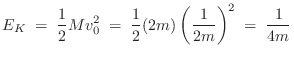
Note that we can also compute $ E_K$ in terms of the total mass $ M=2m$ and the velocity of the center of mass $ v_0=1/(2m)$:

$\displaystyle E_K \eqsp \frac{1}{2} Mv_0^2 \eqsp \frac{1}{2}
(2m)\left(\frac{1}{2m}\right)^2 \eqsp \frac{1}{4m}
$


Previous: Two Masses Connected by a Rod
Next: Striking One of the Masses

Order a Hardcopy of Physical Audio Signal Processing


About the Author: Julius Orion Smith III
Julius Smith's background is in electrical engineering (BS Rice 1975, PhD Stanford 1983). He is presently Professor of Music and Associate Professor (by courtesy) of Electrical Engineering at Stanford's Center for Computer Research in Music and Acoustics (CCRMA), teaching courses and pursuing research related to signal processing applied to music and audio systems. See http://ccrma.stanford.edu/~jos/ for details.


Comments


No comments yet for this page


Add a Comment
You need to login before you can post a comment (best way to prevent spam). ( Not a member? )