Traveling-Wave Partial Derivatives
Because we have defined our traveling-wave components
 and
and
 as having arguments in units of time, the partial
derivatives with respect to time
as having arguments in units of time, the partial
derivatives with respect to time  are identical to simple
derivatives of these functions. Let
are identical to simple
derivatives of these functions. Let
 and
and
 denote the
(partial) derivatives with respect to time of
denote the
(partial) derivatives with respect to time of  and
and  ,
respectively. In contrast, the partial derivatives with respect to
,
respectively. In contrast, the partial derivatives with respect to  are
are
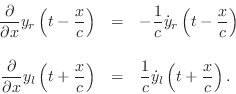
Denoting the spatial
partial derivatives by  and
and
 , respectively, we can write more succinctly
![\begin{eqnarray*}
y'_r&=& -\frac{1}{c}{\dot y}_r\\ [5pt]
y'_l&=& \frac{1}{c}{\dot y}_l,
\end{eqnarray*}](http://www.dsprelated.com/josimages_new/pasp/img3234.png)
where this argument-free notation assumes the same and for all
terms in each equation, and the subscript  or
or  determines
whether the omitted argument is
determines
whether the omitted argument is  or
or  .
.
Now we can see that the second partial derivatives in are

These relations, together with the fact that partial differention is a linear operator, establish that

 for all
twice-differentiable functions and .
for all
twice-differentiable functions and .
Next Section:
Use of the Chain Rule
Previous Section:
FDA of the Ideal String