







N-Channel Polyphase Decomposition
![\includegraphics[scale=0.8]{eps/polytime}](http://www.dsprelated.com/josimages_new/sasp2/img1965.png)
For the general case of arbitrary  , the basic idea is to decompose
 into its periodically interleaved subsequences, as indicated
schematically in Fig.11.9. The polyphase decomposition into
channels is given by
into its periodically interleaved subsequences, as indicated
schematically in Fig.11.9. The polyphase decomposition into
channels is given by
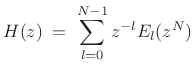
where the subphase filters are defined by
 |
(12.12) |
with
 |
(12.13) |
The signal
 can be obtained by passing
  through an
advance of
through an
advance of  samples, followed by downsampling by the factor
.
as shown in Fig.11.10.
samples, followed by downsampling by the factor
.
as shown in Fig.11.10.
![\begin{psfrags}
% latex2html id marker 29755\psfrag{M}{{\normalsize $N$}}\psfrag{ztl}{{\Large $z^l$}}\psfrag{h[n]}{{\Large $h(n)$}}\psfrag{eln}{{\Large $e_l(n)$}}\begin{figure}[htbp]
\includegraphics[width=0.5\twidth]{eps/polypick}
\caption{Advance by $l$\ samples followed by a downsampling by the factor $N$.}
\end{figure}
\end{psfrags}](http://www.dsprelated.com/josimages_new/sasp2/img1970.png)
Next Section:
Type II Polyphase Decomposition
Previous Section:
Two-Channel Case












