







Overlap-Save Method
The classical overlap-save method [198,277], unlike OLA, uses no zero padding to prevent time aliasing. Instead, it
- (1)
- discards output samples corrupted by time aliasing each frame, and
- (2)
- overlaps the input frames by the same amount.
More specifically:
- If the input frame size is
 and the filter
length is
and the filter
length is  , then a length
FFT and IFFT are used.
, then a length
FFT and IFFT are used.
- As a result,
 samples of the output are invalid due to time aliasing.
- The overlap-save method writes out the good
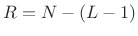 samples
and uses a hop size of
samples
and uses a hop size of  , thus recomputing the time-aliased output
samples in the previous frame.
, thus recomputing the time-aliased output
samples in the previous frame.
samples of
the previous frame are ``saved'' for computing the next frame.
Next Section:
Time Varying OLA Modifications
Previous Section:
Dual of Constant Overlap-Add












