







Radians versus Cycles
Our usual frequency variable is  in radians per second.
However, certain Fourier theorems are undeniably simpler and more
elegant when the frequency variable is chosen to be
in radians per second.
However, certain Fourier theorems are undeniably simpler and more
elegant when the frequency variable is chosen to be  in
cycles per second. The two are of course related by
in
cycles per second. The two are of course related by
 |
(B.1) |
As an example,
 is more compact than
 .
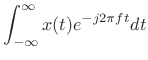
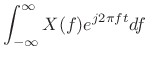
On the other hand, it is nice to get rid of all normalization
constants in the Fourier transform and its inverse:
.
On the other hand, it is nice to get rid of all normalization
constants in the Fourier transform and its inverse:
 |
 |
 |
(B.2) |
 |
|
 |
(B.3) |
The ``editorial policy'' for this book is this: Generally,
is preferred, but
is used when considerable
simplification results.
Next Section:
Differentiation Theorem
Previous Section:
Fourier Transform Notation












