







Sampling Theory
The dual of the Poisson Summation Formula is the continuous-time
aliasing theorem, which lies at the foundation of elementary
sampling theory [264, Appendix G]. If  denotes a
continuous-time signal, its sampled version
denotes a
continuous-time signal, its sampled version  ,
,
 , is
associated with the continuous-time signal
, is
associated with the continuous-time signal
 |
(B.60) |
where
 denotes the (fixed) sampling interval in seconds. The
sampled signal values
are thus treated mathematically as
coefficients of impulses at the sampling instants. Taking the Fourier
transform gives
denotes the (fixed) sampling interval in seconds. The
sampled signal values
are thus treated mathematically as
coefficients of impulses at the sampling instants. Taking the Fourier
transform gives

where
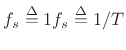 denotes the sampling rate
in radians per second. Note that
denotes the sampling rate
in radians per second. Note that  is periodic
with period
is periodic
with period  . We see that if
  is bandlimited to
less than
radians per second, i.e., if
is bandlimited to
less than
radians per second, i.e., if  for all
 , then only the
  term will be
nonzero in the summation over
term will be
nonzero in the summation over  , and this means there is no
aliasing. The terms
, and this means there is no
aliasing. The terms  for
for  are all
aliasing terms.
are all
aliasing terms.
Next Section:
The Uncertainty Principle
Previous Section:
Poisson Summation Formula












