







Simple Examples of Perfect Reconstruction
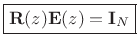
If we can arrange to have
 |
(12.55) |
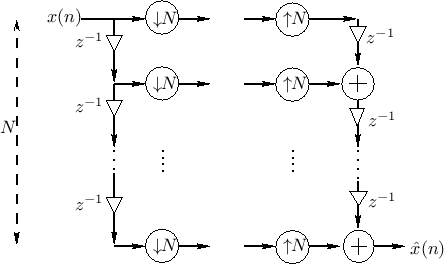
then the filter bank will reduce to the simple system shown in Fig.11.23.
 inverts
  .
.
Thus, when  and
and
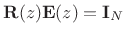 ,
we have a simple parallelizer/serializer,
which is perfect-reconstruction by inspection: Referring to
Fig.11.23, think of the input samples
,
we have a simple parallelizer/serializer,
which is perfect-reconstruction by inspection: Referring to
Fig.11.23, think of the input samples  as ``filling'' a
length
as ``filling'' a
length  delay line over
sample clocks. At time 0
, the
downsamplers and upsamplers ``fire'', transferring
delay line over
sample clocks. At time 0
, the
downsamplers and upsamplers ``fire'', transferring  (and
zeros) from the delay line to the output delay chain, summing with
zeros. Over the next
clocks,
makes its way toward the
output, and zeros fill in behind it in the output delay chain.
Simultaneously, the input buffer is being filled with samples of
. At time
,
makes it to the output. At time
(and
zeros) from the delay line to the output delay chain, summing with
zeros. Over the next
clocks,
makes its way toward the
output, and zeros fill in behind it in the output delay chain.
Simultaneously, the input buffer is being filled with samples of
. At time
,
makes it to the output. At time  ,
the downsamplers ``fire'' again, transferring a length
``buffer''
[
,
the downsamplers ``fire'' again, transferring a length
``buffer''
[ :
: ] to the upsamplers. On the same clock pulse, the
upsamplers also ``fire'', transferring
samples to the output delay
chain. The bottom-most sample [
] to the upsamplers. On the same clock pulse, the
upsamplers also ``fire'', transferring
samples to the output delay
chain. The bottom-most sample [
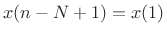 ] goes out immediately
at time
. Over the next
sample clocks, the length
output buffer will be ``drained'' and refilled by zeros.
Simultaneously, the input buffer will be replaced by new samples of
. At time
] goes out immediately
at time
. Over the next
sample clocks, the length
output buffer will be ``drained'' and refilled by zeros.
Simultaneously, the input buffer will be replaced by new samples of
. At time  , the downsamplers and upsamplers ``fire'', and
the process goes on, repeating with period
. The output of the
-way parallelizer/serializer is therefore
, the downsamplers and upsamplers ``fire'', and
the process goes on, repeating with period
. The output of the
-way parallelizer/serializer is therefore
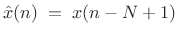 |
(12.56) |
and we have perfect reconstruction.
Next Section:
Sliding Polyphase Filter Bank
Previous Section:
Orthogonal Two-Channel Filter Banks












